

Wealth That Rots
James 5:1-6
There is something deeply unsettling about James 5:1-6. The passage is not merely a warning about money or a reminder that earthly possessions are temporary. It is a prophetic confrontation with a heart that has become so consumed by wealth, comfort, and self-indulgence that it no longer sees the suffering of others.
As I meditated on this passage, I was reminded of the connection between James 4:17 and James 5:1-6. James had just written, “So whoever knows the right thing to do and fails to do it, for him it is sin” (James 4:17, ESV).
Now he exposes what happens when people who have the resources and opportunity to do good choose instead to exploit others and protect their own comfort.
This passage challenged me to examine not only what I possess, but also the heart with which I possess it.
When Wealth Becomes a Witness Against Us
James 5:1-3
James begins with a strong prophetic warning:
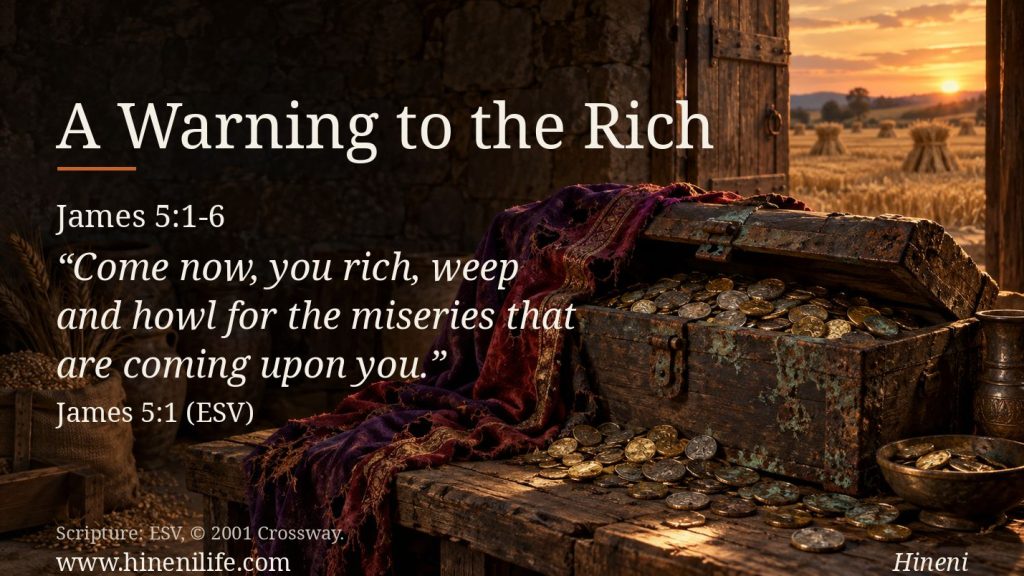
“Come now, you rich, weep and howl for the miseries that are coming upon you!”
– James 5:1, ESV
The language is intense. James calls the rich to weep and howl because judgment is coming. He describes their riches as corrupted, their garments as moth-eaten, and their gold and silver as corroded.
Gold and silver do not ordinarily rust like iron. James uses striking imagery to expose the futility of wealth that has been accumulated and hoarded selfishly. What these people considered their security would become evidence against them.
The words “You have heaped up treasure in the last days” are particularly sobering (v. 3).
They were accumulating wealth while living in a time when they should have been conscious of God’s coming judgment. Their treasure was increasing, but their hearts were moving further away from God’s purposes.
This reminds me that wealth is not a reliable foundation for life. Possessions may provide comfort and security for a season, but they cannot protect us from the judgment of God.
The question is not simply whether we have accumulated something valuable. The question is whether what we have accumulated reflects faithful stewardship or selfishness.
God Hears the Cry of the Oppressed
James 5:4
James now moves from the condition of their wealth to the way it was acquired.
“Behold, the wages of the laborers who mowed your fields, which you kept back by fraud, are crying out against you…”
– James 5:4, ESV
In the ancient world, many laborers depended on their daily wages for their immediate needs. Withholding their payment was not merely an unfair business practice. It could deprive them and their families of their necessities.
James declares that their cries have reached the ears of the Lord of hosts.
The Lord of hosts is the sovereign God who commands the heavenly armies. The wealthy oppressors may have had power and influence on earth, but they were not beyond the reach of God’s justice.
This verse reminds me that God sees what people may overlook. He hears the cries of those who are treated unfairly.
Our faith cannot be separated from how we treat people. Whether in our workplace, business, ministry, or personal relationships, honesty and fairness matter to God.
It is possible to appear successful before people while living in a way that is displeasing to the Lord.
When Comfort Makes Us Blind
James 5:5
James continues:
“You have lived on the earth in luxury and in self-indulgence. You have fattened your hearts in a day of slaughter.”
– James 5:5, ESV
The picture is disturbing. These people were living in luxury while others were suffering. Their hearts had become comfortable with self-indulgence.
James does not teach that every form of comfort or enjoyment is sinful. Scripture does not condemn the possession of wealth in itself. Abraham and Job, for example, were wealthy men. The issue in this passage is the selfish accumulation and use of wealth, especially when it comes through injustice and is enjoyed without concern for the vulnerable.
What makes this passage challenging is that self-indulgence can gradually make us insensitive.
When our lives revolve around our own comfort, we may no longer notice the needs of others. We may become so accustomed to what we have that we forget it is something entrusted to us by God.
Am I becoming more compassionate as God blesses me, or am I becoming more comfortable with ignoring the needs around me?
The Seriousness of Oppressing the Righteous
James 5:6
James concludes with a severe accusation:
“You have condemned and murdered the righteous person. He does not resist you.”
– James 5:6, ESV
The language of condemnation and murder shows the seriousness of the oppression James is addressing. Through their power and unjust practices, the wealthy were destroying the lives of innocent people who had little ability to resist them.
The passage may include literal violence, but it also exposes the destructive consequences of economic and social oppression.
God does not treat injustice as a small matter.
The powerless may be unable to defend themselves before those who hold authority, but their suffering is not hidden from God. James reminds us that the Lord sees, hears, and will judge.
This is a warning to anyone who uses influence, position, or resources to take advantage of others.
Being Rich Is Not the Sin
As I reflect on this passage, I do not want to conclude that possessing wealth is inherently sinful.
The Bible does not condemn wealth itself. Rather, it warns us about trusting in riches, loving money, accumulating possessions selfishly, and using wealth unjustly.
Jesus’ encounter with the rich ruler in Luke 18:18-27 reveals how possessions can become an obstacle to wholehearted devotion to God. The parable of the rich fool in Luke 12:16-21 reminds us of the danger of storing up treasures for ourselves while failing to be rich toward God.
Wealth can be used to provide for our families, support ministry, pay workers fairly, and help those in need. It can become a means of blessing when it is placed under God’s authority.
The issue is the heart.
What God has entrusted to us should not become an object of pride, greed, or selfish security. It should be handled with humility and faithfulness.
The Whole Thread: Pride, Omission, and Injustice
James 5:1-6 becomes even more meaningful when we read it alongside the preceding verses.
In James 4:13-16, we see the danger of making plans with pride, as though tomorrow belongs to us.
In James 4:17, we are reminded that knowing the good we ought to do and failing to do it is sin.
In James 5:1-6, James exposes those who go further – not merely neglecting to do good, but actively exploiting others while living in selfish luxury.
The progression is sobering.
Pride can shape how we plan our lives. Selfishness can influence what we choose to do with our resources. And when our hearts become consumed with our own interests, we may become blind to the people God has placed around us.
As I meditate on this passage, I am reminded that faithful Christian living involves more than avoiding obvious wrongdoing. It also means using what God has entrusted to us in ways that reflect His character.
The question is not simply, “How much do I possess?”
It is also, “Am I using what God has placed in my hands faithfully?”
Am I earning honestly? Am I treating people fairly? Am I sensitive to the needs of others? Am I willing to share rather than merely accumulate?
James does not allow me to examine wealth only from the perspective of financial success. He brings it before the Lord and asks me to examine my heart.
Heavenly Father, thank You for reminding me through Your Word that everything I possess comes from You. Guard my heart from greed, pride, and selfishness. Help me not to find my security in earthly riches or become blind to the needs of others. Teach me to use what You have entrusted to me with humility, honesty, justice, and compassion. May I never use my position or resources to oppress others, but may my life reflect Your goodness and love. Search my heart and show me where I have neglected to do what is right. Help me to be a faithful steward of all that You have given me. In Jesus’ name, Amen.
Hineni