

The Presence We Must Not Take for Granted
Exodus 30:1-10
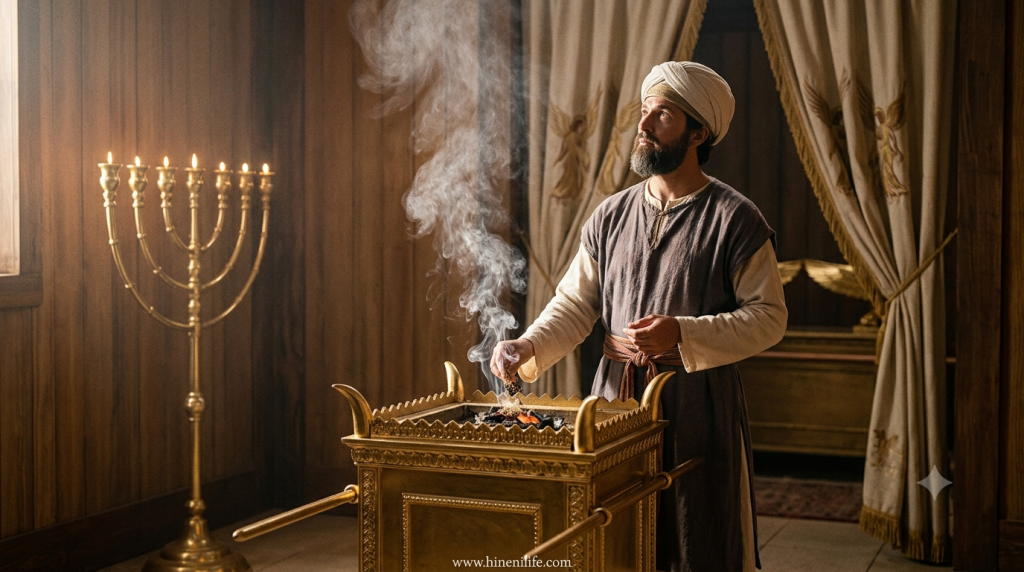
Yesterday, as we came to the end of Exodus 29, we saw something profound: God did not merely bring Israel out of Egypt, establish their priesthood, and give them sacrifices. He said, “I will dwell among the people of Israel and will be their God.” The purpose of redemption was moving toward fellowship – God dwelling among His people.
Immediately after this, Exodus 30 introduces another important part of the tabernacle: the altar of incense.
This was different from the bronze altar of burnt offering. The bronze altar stood in the courtyard, where the sacrifices were offered. The golden altar of incense stood inside the Holy Place, immediately before the veil that separated the Holy Place from the Most Holy Place, where the ark and mercy seat were located.
God gave Moses precise instructions concerning its construction and its use. Aaron was to burn fragrant incense on it every morning and again at twilight. It was to be a regular offering before the LORD. And God specifically prohibited unauthorized incense or other offerings from being placed on that altar.
There was a God-appointed place, a God-appointed purpose, and a God-appointed manner of approaching Him.
And as I read this passage, I found myself asking: What is God teaching me through this altar?
God Who Dwells Also Calls Us to Remain Before Him
The connection with yesterday’s passage is difficult to miss.
God said:
“I will dwell among the people of Israel.”
Now He establishes a place where the priest continually ministers before Him.
The God who chooses to dwell among His people is not calling them into an occasional relationship with Him.
The incense was offered in the morning and at twilight. Exodus calls it “a regular incense offering before the LORD.”
The Old Covenant ritual itself is not something we reproduce today. We do not have a physical incense altar, and we do not have Aaron’s priesthood. But Scripture later gives us a significant connection between incense and prayer.
David prayed:
“Let my prayer be counted as incense before you.”
– Psalm 141:2 ESV
And Revelation describes incense in connection with the prayers of the saints.
The New Testament repeatedly calls us toward a life of continual prayer.
Paul writes:
“Pray without ceasing.”
– 1 Thessalonians 5:17 ESV
Therefore, the lesson is not simply that I should pray once in the morning and once in the evening.
It is much deeper: My relationship with God should not be occasional.
Not Just Visiting God’s Presence
Sometimes I can unconsciously divide my life into different compartments.
There is my prayer life. There is my work. There is my family. There is my ministry. There are my plans. There are my private decisions.
But if God truly dwells with His people, then there is no part of my life where I can say, “This area is mine; God does not need to be involved here.”
For the New Testament believer, this becomes even more profound.
The Holy Spirit dwells in us.
Our whole life is lived before God.
So Christianity cannot simply mean that I visit God’s presence during a church service, a prayer meeting, or a devotional time and then return to living according to my own desires.
The presence of God is not an appointment in my calendar. It is the reality in which my entire life is lived.
That is what makes the idea of abiding in Christ so meaningful.
Jesus said:
“Abide in me, and I in you.”
– John 15:4 ESV
Abiding is not occasional.
It is continuing. It is remaining. It is living in dependence upon Christ.
God Is Holy – and His Presence Is Not Casual
But Exodus 30 also gives us a necessary correction.
Verse 9 says:
“You shall not offer unauthorized incense on it.”
God had given a specific purpose for this altar.
The priest could not decide: “I think I will do something different today.”
The altar belonged to God, and therefore God’s instructions determined how it was to be used.
This is a reminder that God’s holiness does not allow us to redesign our relationship with Him according to our convenience.
We sometimes say: “God knows my heart.”
Yes, He does. But that truth should lead us toward obedience, not away from it.
God knows our hearts – and therefore He knows when our “convenience” has become more important to us than obedience. He knows when we have taken His Word seriously only when it agrees with what we already want. He knows when we have created a version of Christianity that is comfortable for us.
The altar of incense reminds me: God determines how He is worshipped.
Our Christian life must therefore be governed by what He has revealed in His Word. Where Scripture commands, we obey. Where Scripture forbids, we refrain. And where Scripture gives freedom, we exercise that freedom under the lordship of Christ – not according to selfish desires.
We Can Approach God – But Never Casually
There is another beautiful tension in this passage.
The altar of incense stood before the veil, near the place associated with God’s presence.
Under the Old Covenant, access to the Most Holy Place was restricted. The priesthood, sacrifices, blood and sanctuary all formed part of the system God established for Israel to approach Him.
But the story does not end there.
The Old Testament points forward to something greater.
Through Jesus Christ, we now have access to God.
Hebrews tells us that Christ is the great High Priest who entered once for all and accomplished what the Old Covenant sacrifices could never finally accomplish.
Because of Christ, we are invited to draw near to God.
That should produce both confidence and reverence.
I can come boldly – not because God has become less holy, but because Christ has accomplished what was necessary for me to approach Him.
Therefore, grace should never make me careless about God. It should make me more grateful, more humble and more willing to remain near Him.
Christ’s Sacrifice Does Not Need to Be Repeated
Exodus 30:10 also reminds us that atonement was made for the altar once every year with the blood of the sin offering.
But the New Testament reveals something radically greater.
Christ does not need to repeat His sacrifice.
His offering was once for all.
Therefore, I do not approach God every day asking Christ to sacrifice Himself again. Instead, because Christ has already accomplished my redemption, I continually confess my sins, repent, and walk in the cleansing fellowship He has secured for me.
As John writes:
“If we confess our sins, he is faithful and just to forgive us our sins and to cleanse us from all unrighteousness.”
– 1 John 1:9 ESV
There is a difference between repeating Christ’s sacrifice and continually walking in the grace of the sacrifice already completed.
The first is unnecessary. The second is essential to Christian living.
What Kind of Life Am I Living?
This passage brings the question very close to my own life.
If God desires to dwell with His people, and if Christ has opened the way for me to approach God, then what am I doing with that privilege?
Am I only coming to God when I need something?
Am I praying only when circumstances become difficult?
Am I spending more time doing things for God than simply being with God?
Can ministry become a substitute for fellowship?
Can Christian activity become a substitute for abiding?
These are uncomfortable questions. But perhaps they are necessary ones.
Because it is possible to be very busy around the things of God while becoming increasingly distant from God Himself.
The altar of incense reminds me that fellowship with God is not an optional addition to ministry. It is the foundation from which everything else should flow.
“Lord, Not My Way – Your Way”
There is one more thing that speaks deeply to me from verse 9.
The priest could not substitute one offering for another. God had already spoken.
And I think this is where the word Hineni becomes very personal.
“Here I am, Lord. Use me.”
But perhaps today’s passage teaches me to say something more:
“Here I am, Lord. Teach me how You want me to live.”
Not: “Lord, I will serve You in the way that is convenient for me.”
But: “Lord, let Your Word define my life.”
Not: “I will give You whatever part of my life I choose.”
But: “My whole life is lived before You.”
Not: “I will come to You occasionally.”
But: “Teach me to abide in You.”
The God Who Dwells Among Us
Yesterday, we heard God say:
“I will dwell among the people of Israel.”
Today, we see the priest continually ministering before Him.
And in Christ, the truth becomes even more astonishing.
God has not merely given us a place where we can occasionally come near Him. Through Christ, He has brought us near.
The Holy Spirit dwells in His people. Jesus calls us to abide in Him. And therefore, the Christian life is not a Sunday life. It is not a ministry life. It is not a prayer-meeting life. It is not a life divided between “spiritual” and “ordinary.”
It is a life lived continually before God.
The question is not merely: “Lord, will You use me?”
It is also: “Lord, will You teach me to remain with You?”
Because perhaps the greatest danger in serving God is not refusing to work for Him. It is becoming so busy working for Him that we forget to be with Him.
Lord, You are holy, and yet through Jesus Christ You have opened the way for me to come into Your presence. Forgive me for the times when I have treated fellowship with You as something occasional or secondary.
Teach me to abide in Christ – not only during my prayer time, not only on Sundays, and not only when I need something from You, but throughout every part of my life.
Guard me from creating a Christian life according to my own convenience. Let Your Word shape my thoughts, my decisions, my relationships, my service and my desires.
Thank You that I do not have to earn access to You. Christ has opened the way. Help me never to take that privilege casually.
Lord, here I am. Teach me. Shape me. Correct me. Let me remain in Your presence, and from that place, use me for Your glory.
Amen.
Hineni