

08 August 2026
A Study of Exodus 26:1–6
The Beauty Hidden Within
“Moreover, you shall make the tabernacle with ten curtains of fine twined linen and blue and purple and scarlet yarns; you shall make them with cherubim skillfully worked into them.”
– Exodus 26:1 (ESV)
Introduction
When we come to Exodus 26, we encounter something that may initially appear to be simply a collection of architectural instructions.
God speaks about curtains, measurements, loops, clasps, coverings, boards, and veils.
At first glance, we may wonder: “What does all this have to do with our spiritual life today?”
But when we slow down and study the passage carefully, we discover that these details are not meaningless. God Himself designed the Tabernacle. Every part had its place. Every measurement had a purpose. And the Tabernacle itself was a picture of God’s dwelling among His people and, ultimately, pointed forward to greater spiritual realities fulfilled in Jesus Christ.
As I was reading Exodus 26:1–6, one particular thought caught my attention:
The beauty of the Tabernacle was hidden within.
Let us first see why we can say that from the text itself.
What Do Exodus 26:1–6 Describe?
In verses 1–6, God instructs Moses to make ten curtains of fine twisted linen, with blue, purple, and scarlet yarn, and with cherubim skillfully woven into them.
These were not ordinary curtains. They were carefully designed according to God’s instructions.
The curtains were joined together into groups and connected with loops and gold clasps.
But how do we know that these were the inner curtains of the Tabernacle?
The answer becomes clearer when we continue reading.
The Verses That Show the Layers
After describing these beautiful linen curtains in verses 1–6, God says in verse 7:
“You shall also make curtains of goats’ hair to be a tent over the tabernacle.”
– Exodus 26:7 (ESV)
Notice the wording: “a tent over the tabernacle.”
God is now describing another layer.
Then, in verses 14, He gives instructions for additional coverings:
“And you shall make for the tent a covering of tanned rams’ skins and a covering of goatskins on top.”
– Exodus 26:14 (ESV)
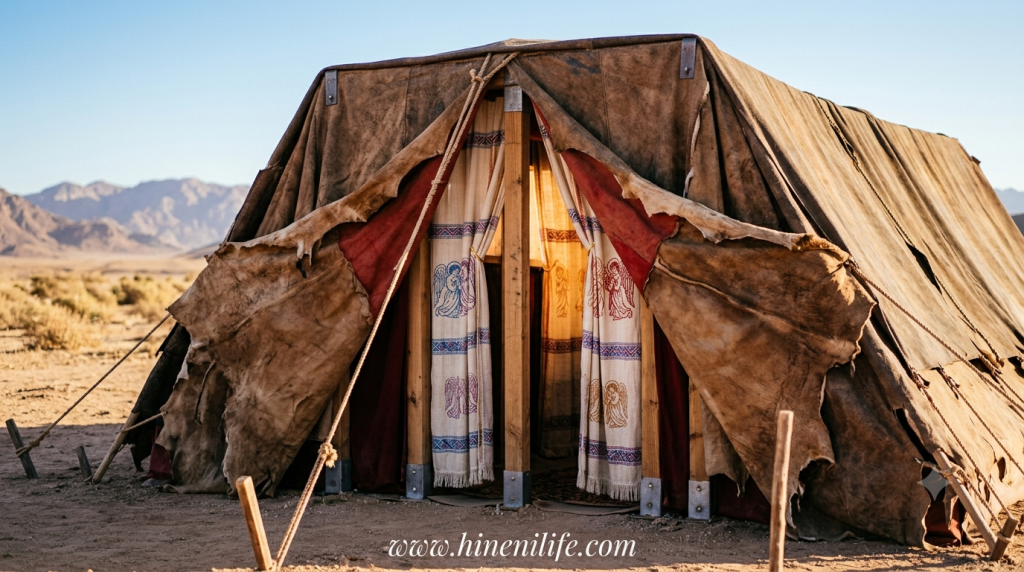
Now the picture becomes clearer. There were successive layers:
Inside: Fine linen curtains with blue, purple, and scarlet yarn and cherubim → Goat-hair curtains → Rams’ skins → Outer covering
Therefore, the curtains described in Exodus 26:1–6 formed the innermost layer of the Tabernacle.
This is important because it tells us something beautiful: The most elaborate beauty was not on the outside. It was within.
Those standing outside the Tabernacle would not see the embroidered cherubim and the beautiful colours of the linen curtains. The beauty was experienced by those who entered the sanctuary.
And that is where the spiritual thought begins.
The Materials Themselves
Before coming to the main spiritual lesson, it is worth pausing over the materials God chose.
Fine linen: Fine linen is repeatedly associated in Scripture with purity and righteousness. It reminds us of the holiness of God and, ultimately, the perfect righteousness we find in Christ.
Blue: Blue naturally draws our thoughts toward heaven. It can remind us that God’s people belong to Him and are called to live with a heavenly perspective.
Purple: Purple was associated with royalty. It beautifully reminds us of Christ the King. Jesus is not merely a teacher or prophet. He is the King of kings and Lord of lords.
Scarlet: Scarlet naturally reminds us of blood and sacrifice. The entire biblical story points toward the necessity of sacrifice for sin and ultimately toward the precious blood of Jesus Christ.
Cherubim: The curtains were decorated with cherubim. Throughout Scripture, cherubim are associated with God’s holy presence. We see them at the entrance to Eden after humanity’s fall, above the Ark of the Covenant, and in prophetic visions of God’s glory. Their presence in the Tabernacle reminds us that this was a place associated with the holy presence of God.
These details are beautiful, but we should be careful not to claim that Scripture explicitly assigns a specific symbolic meaning to every colour in Exodus 26. The primary purpose of the passage is to describe the Tabernacle according to God’s instructions. Yet these details can certainly remind us of truths that Scripture teaches elsewhere.
The Beauty That Could Not Be Seen From Outside
This is what particularly touched me.
Imagine an Israelite standing outside the Tabernacle. What would he see?
He would see the outer coverings. He would not see the beautiful linen curtains. He would not see the embroidered cherubim. He would not see the beauty of the colours woven into the inner curtains.
The beauty was hidden.
Only those who entered the sanctuary could see it.
This gives us a powerful picture for our spiritual lives.
God Looks Beyond the Outward Appearance
This principle is not limited to Exodus. It is found throughout Scripture.
When Samuel was looking at Jesse’s sons and trying to determine whom God had chosen, the Lord told him:
“Man looks on the outward appearance, but the LORD looks on the heart.”
– 1 Samuel 16:7 (ESV)
Human beings naturally look at what is visible. God looks deeper.
We look at appearance. God looks at the heart.
We look at achievements. God looks at motives.
We look at public ministry. God looks at private devotion.
We look at what people know about us. God knows what nobody else sees.
Jesus Gave a Very Similar Teaching
This becomes even clearer when we listen to the words of Jesus.
Jesus strongly rebuked the Pharisees because they were extremely careful about outward religious appearance while neglecting the condition of their hearts. He said:
“You clean the outside of the cup and the plate, but inside they are full of greed and self-indulgence.”
Then He said:
“First clean the inside of the cup and the plate, that the outside also may be clean.”
– Matthew 23:25–26 (ESV)
What a powerful statement: “First clean the inside.”
Jesus was not saying that the outside does not matter. He was teaching that the inside must come first. When the heart is transformed, the outward life begins to change.
True Christianity is not simply about looking right before people. It is about becoming right before God.
The Danger of Outward Christianity
It is possible to look spiritually healthy while the inner life is unhealthy.
A person can:
- attend church
- read the Bible
- pray publicly
- serve in ministry
- speak Christian language
- appear committed
and yet have a heart that is far from God.
This was precisely the problem Jesus confronted in the Pharisees. Their outward religious appearance was impressive. But Jesus could see what was happening inside.
That should make every one of us pause.
The question is not merely: “How do people see me?”
The deeper question is: “How does God see me?”
The Hidden Life Matters
There is a part of our Christian life that nobody else sees.
Our private prayers. Our thoughts. Our motives. Our temptations. Our struggles. Our repentance. Our obedience when nobody is watching. Our love for God when there is no audience.

This is the hidden life.
And God sees it all.
Jesus repeatedly taught His disciples about this hidden relationship with the Father. He spoke about praying in secret. He spoke about giving without seeking recognition. He spoke about fasting without displaying it before others.
Why?
Because Christianity is not fundamentally a performance before people. It is a relationship with God.
Christ Himself Was Not Recognized by Outward Appearance
There is another beautiful connection.
Isaiah prophesied concerning the coming Messiah:
“He had no form or majesty that we should look at him, and no beauty that we should desire him.”
– Isaiah 53:2 (ESV)
When Jesus came into the world, many people did not recognize who He truly was. They saw Jesus of Nazareth. They saw a carpenter. They saw a man.
But those who came to Him in faith began to see something deeper.
John wrote:
“The Word became flesh and dwelt among us, and we have seen His glory.”
– John 1:14 (ESV)
His glory was not something that everyone recognized by looking at His outward appearance. His true identity was revealed to those who came to know Him. The disciples discovered the beauty of Christ through walking with Him.
And this is still true today. The more closely we walk with Jesus, the more we discover His beauty.
What Is the Condition of My Inner Life?
Exodus 26:1–6 therefore becomes more than a study of ancient curtains. It becomes an opportunity for self-examination.
We should ask ourselves: “What does my inner life look like?”
Is there bitterness hidden inside? Is there pride? Is there unforgiveness? Is there hypocrisy? Is there a secret sin? Are my motives pure? Do I love God when nobody is watching? Is prayer a genuine relationship with God or merely a religious activity? Am I more concerned about appearing spiritual than actually becoming holy?
These are uncomfortable questions. But God’s Word is meant to bring us into the light.
God Wants to Transform Us From Within
The good news is that God does not merely expose what is wrong. He transforms.
The Holy Spirit works within us. God promised through Ezekiel:
“I will give you a new heart, and a new spirit I will put within you.”
– Ezekiel 36:26 (ESV)
This is the work of grace. God changes the heart. And when the heart changes, the life begins to change.
Our words change. Our attitudes change. Our relationships change. Our priorities change. Our actions change.
The outward life becomes a reflection of what God is doing within.
The Church Is Also Called to Have an Inner Beauty
Peter gives another beautiful perspective:
“Let your adorning be the hidden person of the heart with the imperishable beauty of a gentle and quiet spirit, which in God’s sight is very precious.”
– 1 Peter 3:4 (ESV)
Notice the expression: “the hidden person of the heart.”
There is a beauty that God sees even when people do not. The world may not notice it. Social media may not celebrate it. People may never applaud it.
But God considers it precious.
That is the beauty we should pursue.
The Question God Asks Us
The Tabernacle’s inner curtains make me ask myself:
“Am I spending more time decorating the outside of my life than allowing God to transform the inside?”
It is easy to improve our appearance. It is much harder to allow God to deal with our heart. It is easy to impress people. It is harder to live faithfully when nobody is watching. It is easy to speak about God. It is harder to walk with God in secret.
But God sees the hidden places. And He desires truth in the inward being.
Conclusion – The Beauty Hidden Within
When I look at Exodus 26:1–6, I see beautiful curtains, precious colours, fine linen, and cherubim.
But beyond the physical beauty, I see a spiritual reminder: God is interested in the beauty within.
The world looks at the outside. God looks at the heart. Jesus warned us not to become like those who carefully clean the outside while neglecting the inside. He said: “First clean the inside…”
Therefore, before asking God to change everything around us, perhaps we should allow Him to search what is within us.
David prayed:
“Search me, O God, and know my heart! Try me and know my thoughts!”
– Psalm 139:23 (ESV)
That is a prayer every believer can make. “Lord, search my heart. Show me what I cannot see. Reveal what needs to be removed. Cleanse what is unclean. Correct what is wrong. And make my inner life beautiful before You.”
The beauty of the Tabernacle was hidden from those standing outside. But God saw it. And our hidden life may also be unseen by people.
But God sees.
May we therefore seek not merely to look right before people, but to be right before God. May Christ be formed in us from the inside out. And may the beauty that God creates within us eventually become visible through the way we live, love, serve, forgive, and walk with Him. The greatest beauty is not what people see. It is what God sees when He looks within. May the good Lord bless you with these words.
Hineni