

12 August 2026
A Thought from My Personal Meditation on Exodus 27:1–8
The Altar: Are We Ready to Surrender?
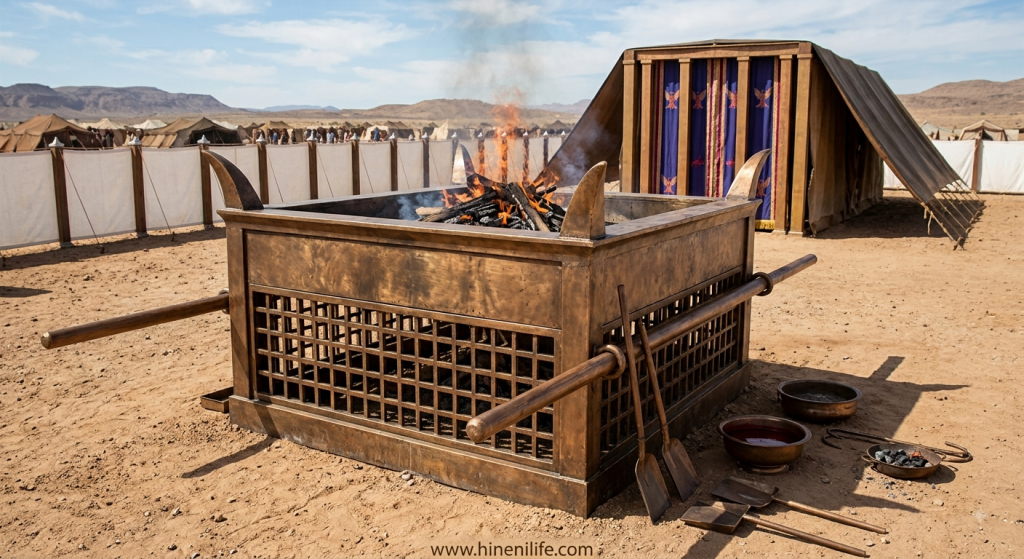
As I was meditating today on Exodus 27:1–8, my attention was drawn to the bronze altar that God instructed Moses to make for the Tabernacle.
At first, these verses may seem to be mainly about construction—the dimensions, the materials, the utensils, the horns and the poles. But when we look beyond the construction, the altar opens up a much deeper spiritual picture.
God gave Moses very specific instructions:
“You shall make the altar of acacia wood, five cubits long and five cubits broad. The altar shall be square, and its height shall be three cubits.”
– Exodus 27:1 (ESV)
The altar was made of acacia wood and overlaid with bronze. It had four horns, one at each corner. The utensils used in connection with it—the pots for removing the ashes, shovels, basins, forks and fire pans—were also to be made of bronze.
Poles made of acacia wood and covered with bronze were provided so that the altar could be carried whenever Israel moved.
And once again, God reminded Moses:
“As it has been shown you on the mountain, so shall it be made.”
– Exodus 27:8 (ESV)
God was concerned about every detail.
But as I looked beyond the construction, one question came to my mind:
“What was the purpose of the altar?”
The altar was the place where sacrifices were offered to God. Something was placed upon the altar and consumed by fire. And when I thought about this, I remembered a question I once heard during a retreat:
“Are we ready for the altar?”
That question stayed with me.
The Altar Was a Place of Sacrifice
The altar reminds us of sacrifice. Throughout the Old Testament, sacrifices were offered in connection with sin, atonement, worship and dedication.
The altar reminded Israel that they were approaching a holy God and that sin could not simply be ignored. Something had to be offered.
But the sacrifices of the Old Testament were not the final answer. They were pointing forward to something greater. They were pointing toward Jesus Christ.
John the Baptist saw Jesus and declared:
“Behold, the Lamb of God, who takes away the sin of the world!”
– John 1:29 (ESV)
The altar therefore makes me look beyond Exodus. It makes me look toward the Cross.
The Altar Points to Jesus Christ
The New Testament makes it clear that the sacrifices of the Old Testament could not finally remove sin.
Hebrews says:
“For it is impossible for the blood of bulls and goats to take away sins.”
– Hebrews 10:4 (ESV)
The sacrifices had to be repeated. But Christ offered Himself once for all.
“But when Christ had offered for all time a single sacrifice for sins, he sat down at the right hand of God.”
– Hebrews 10:12 (ESV)
This is one of the most beautiful truths of the Gospel. The Old Testament altar speaks about sacrifice. The Cross reveals the ultimate sacrifice.
The animals were offered repeatedly. Jesus offered Himself once for all.
The sacrifices pointed forward. Christ fulfilled what they were pointing toward.
The altar therefore directs my eyes to Calvary.
Jesus Became the Sacrifice for Me
Jesus did not merely come to teach us how to live. He came to give His life for us. He willingly accepted the suffering of the Cross.
Peter writes:
“He himself bore our sins in his body on the tree, that we might die to sin and live to righteousness.”
– 1 Peter 2:24 (ESV)
There is something very personal in those words: “He himself bore our sins.”
He did it for me. He took what I could never take away myself. He paid what I could never pay. He became the sacrifice I needed.
And therefore, when I look at the altar, I don’t simply see an Old Testament object. I see a picture that directs me toward Christ and His finished work on the Cross.
From His Sacrifice to My Surrender
But there is another important question. If Christ gave Himself completely for me, what should my response be?
Paul gives us the answer:
“I appeal to you therefore, brothers, by the mercies of God, to present your bodies as a living sacrifice, holy and acceptable to God, which is your spiritual worship.”
– Romans 12:1 (ESV)
Notice the words: “Living sacrifice.”
Christ’s sacrifice was once for all. Our response is a daily surrender.
We are not offering ourselves to earn salvation. Christ has already accomplished salvation. We surrender ourselves because He first gave Himself for us.
This distinction is important. I don’t surrender my life so that God will love me. I surrender because God has already loved me.
Paul says:
“But God shows his love for us in that while we were still sinners, Christ died for us.”
– Romans 5:8 (ESV)
His sacrifice is the foundation. Our surrender is the response.
What Does It Mean to Become “Nothing”?
When I think about the sacrifice being consumed on the altar and becoming ashes, I am reminded of the need to become “nothing” before God.
But this needs to be understood correctly. God does not want us to destroy our personality, our abilities, our legitimate desires, our health, our career or our responsibilities.
Rather, self must no longer sit on the throne.
My ambitions must come under His will. My plans must come under His purpose. My abilities must become available for His glory. My possessions must be placed in His hands. My career must be surrendered to Him. My relationships must be surrendered to Him. My health must be entrusted to Him. My thoughts, attitudes and intentions must be brought before Him. Everything I have must be held with an open hand.
The question is not: “Do I have ambitions?” The question is: “Are my ambitions surrendered to God?”
It is not: “Do I have plans?” But: “Are my plans under God’s authority?”
It is not: “Do I have abilities?” But: “Am I willing to use them for His glory?”
That is what surrender means.
Even Our Anger Must Come to the Altar
Perhaps one of the most practical places where surrender is tested is in our relationships.
Someone says something against us. Someone insults us. Someone treats us unfairly. Someone disappoints us. And immediately something rises within us: anger.
Anger can be a genuine emotional response to something wrong. Scripture does not pretend that we will never experience anger. But the question is: “What happens to that anger inside us?”
Does it become bitterness? Does it become resentment? Does it produce harsh words? Does it make us desire revenge? Do we keep replaying the incident in our minds? Do we refuse to forgive? Do we allow wounded pride to control our behaviour?
Paul says:
“Be angry and do not sin; do not let the sun go down on your anger.”
– Ephesians 4:26 (ESV)
The Christian life is not simply about controlling our outward behaviour. Christ wants to transform what is happening inside us.
When I am hurt, my hurt must come to the altar. When I am angry, my anger must come to the altar. When my pride is wounded, my pride must come to the altar. When I want revenge, that desire must come to the altar. When I struggle to forgive, my unforgiveness must come to the altar.
Jesus said:
“But I say to you, Love your enemies and pray for those who persecute you.”
– Matthew 5:44 (ESV)
That is not our natural response. That is Christ being formed in us.
Perhaps it is easy to say: “Lord, I surrender my future to You.” But what happens when someone hurts me? Can I say: “Lord, I surrender my anger to You. I surrender my wounded pride. I surrender my desire for revenge. Help me to forgive as You have forgiven me.” That is also the altar.
The Altar of Daily Surrender
Jesus said:
“If anyone would come after me, let him deny himself and take up his cross daily and follow me.”
– Luke 9:23 (ESV)
There is one word here that I don’t want to overlook: “Daily.”
Following Jesus is not simply one great decision made sometime in the past. Every day I have to surrender. Every day I have to deny myself. Every day I have to choose God’s will over my own. Every day I have to take up my cross and follow Him.
Sometimes the greatest spiritual battles are not dramatic ones. Sometimes they happen in very ordinary moments.
Someone speaks harshly to me. Will I respond with harshness? Or will I surrender my reaction to Christ?
Someone receives recognition that I wanted. Will I become jealous? Or will I surrender my desire for recognition?
My plans fail. Will I become bitter? Or will I trust God?
Someone treats me unfairly. Will I seek revenge? Or will I surrender the matter to God?
That is where the altar becomes real in everyday life.
What Needs to Be Placed on My Altar?
As I continued meditating, I began asking myself some difficult questions.
What about my ambitions? Have I surrendered them to God?
What about my career? Am I allowing God to direct it?
What about my desires? Are they under His authority?
What about my pride? Am I willing to humble myself?
What about my thoughts? Are they pleasing to Him?
What about my words? Do they reflect Christ?
What about my attitudes? Do they reveal the character of Jesus?
What about my intentions? Even when my actions appear good outwardly, what is happening inside my heart?
What about the things I watch and listen to? What influences my mind?
What about my anger? What about my unforgiveness? What about my desire for revenge? What about my time? What about my money? What about my relationships? What about the things I secretly want to control?
These things also need to come before the altar.
The Goal Is Not Emptiness but Christlikeness
There is something beautiful about this. God is not asking us to surrender ourselves so that our lives become empty. He is asking us to surrender what does not belong there so that Christ may be formed in us.
Paul expressed this desire:
“My little children, for whom I am again in the anguish of childbirth until Christ is formed in you!”
– Galatians 4:19 (ESV)
And Romans tells us that we are being:
“conformed to the image of his Son”
– Romans 8:29 (ESV)
This changes how I look at my daily life. Perhaps God is using circumstances I don’t understand to form Christ in me. A difficult relationship may be teaching me patience. A disappointment may be dealing with my dependence on my own plans. Waiting may be teaching me trust. Correction may be dealing with my pride. Suffering may be teaching me dependence. Success may be testing whether I will give God the glory.
Through all these things, God can be shaping me into the image of Christ. The goal of Christian life is not merely to become a better version of myself. The goal is to become more like Jesus.
The Altar and the Christian Life
The altar therefore gives us a beautiful progression:
The altar → sacrifice
The Cross → Christ’s sacrifice
Christ’s sacrifice → our surrender
Our surrender → transformation
Transformation → Christlikeness
This is why the bronze altar is still spiritually meaningful to a New Testament believer. We are not returning to the Old Testament sacrificial system. Christ has fulfilled it. But we are called to live in the reality that His sacrifice has purchased for us. Our lives belong to Him.
Am I Ready for the Altar?
So I come back to the question I heard during that retreat:
“Are we ready for the altar?”
Am I ready to place my ambitions there? My career? My plans? My pride? My anger? My unforgiveness? My desire for revenge? My need for recognition? My fears? My future? My hidden thoughts? My whole life?
Can I sincerely say:
“Lord, everything I have belongs to You. My life belongs to You. My future belongs to You. My gifts belong to You. My career belongs to You. My relationships belong to You. My body belongs to You. My thoughts belong to You. My desires belong to You. My reactions belong to You. My whole life belongs to You.”
That is the meaning of a living sacrifice.
The Altar as a Mirror
As I have shared in my earlier meditations, I don’t want to stand before others as someone who has already reached perfection. I am also standing before the same mirror.
The Word of God examines me first.
So today I want to ask myself:
Is my life truly surrendered to Christ?
What am I still holding back from Him?
Is there something God has already asked me to surrender, but I am resisting?
Is self still sitting on the throne of my heart?
Are my ambitions surrendered to God’s purpose?
Are my thoughts becoming more like Christ’s thoughts?
Are my words becoming more like His words?
Are my attitudes becoming more like His attitudes?
Are my intentions pure before God?
When someone hurts me, what comes out of me?
Does my response reveal Christ or reveal self?
Is Christ being formed in me?
These questions are not meant to condemn me. They are invitations to come closer to Christ. When the Holy Spirit reveals something through the Word of God, my response should not be self-justification.
It should be: Confession. Repentance. Surrender. Grace. And then continuing to walk with Christ.
A Final Thought
The bronze altar was a place where sacrifices were offered. Today, because of Christ’s once-for-all sacrifice, we do not need to bring an animal to an altar. Jesus has already paid the price.
The Cross is not asking me to earn salvation. The Cross is asking me to respond to grace.
And my response is: “Lord, here I am. My life belongs to You.”
The altar reminds me of death to self. The Cross reminds me of Christ’s complete sacrifice. The living sacrifice reminds me of my daily surrender. And Christlikeness is the goal toward which God is leading me.
Christ gave Himself for me. Now I want to give myself completely to Him. Lord, take my ambitions, my desires, my plans, my pride, my thoughts, my attitudes, my anger, my unforgiveness, my relationships, my career, my future—everything—and bring them under Your will. Let self decrease. Let Christ increase. Let my life become a living sacrifice. “I appeal to you therefore, brothers, by the mercies of God, to present your bodies as a living sacrifice, holy and acceptable to God, which is your spiritual worship.” — Romans 12:1 (ESV). The sacrifice of Christ is complete. Now the surrender of my life must be daily. The altar points me to the Cross. The Cross points me to Christ. And Christ calls me to surrender.
-Hineni