

Taming the Unruly Tongue
James 3:1-12
In James 1:26, we encountered a searching truth: a person who considers himself religious but does not bridle his tongue deceives his own heart. In James 2, we learned that genuine faith must express itself through practical love and obedience.
Now, in James 3, James returns to the tongue and exposes how deeply our speech reveals the condition of our hearts.
We may pray, worship, study Scripture, and speak about spiritual things. But what happens when we are irritated, misunderstood, corrected, or treated unfairly? Do our words reflect the character of Christ, or do they reveal attitudes that still need to be surrendered to Him?
The Weight of Our Words
“Not many of you should become teachers, my brothers, for you know that we who teach will be judged with greater strictness. For we all stumble in many ways.”
– James 3:1-2, ESV
James begins by warning believers not to rush into the role of teachers. Those who teach God’s Word carry a serious responsibility because their words influence how others understand the truth and live their lives. They will face stricter judgment because of that responsibility.
But James immediately reminds us that we all stumble in many things. He includes himself in this admission.
He then explains that if someone does not stumble in what he says, he is a mature person who can also bridle his whole body (v. 2).
The point is not that we can achieve sinless perfection through perfect speech. Rather, the tongue is a powerful indicator of spiritual maturity because controlling our words requires restraint over our reactions, desires, and attitudes.
This challenges me to examine my speech, especially in ordinary situations. It is easy to sound spiritual when praying or sharing Scripture. But my words at home, at work, and in moments of disagreement may reveal much more about what is happening within me.
Small Things Can Change the Direction of Our Lives
James gives three illustrations to show how something small can exercise tremendous influence.
The horse’s bit (v. 3): A small bit in a horse’s mouth can direct its powerful body. In the same way, our tongue, though small, can influence our actions and relationships.
The ship’s rudder (v. 4): A huge ship driven by strong winds can be directed by a relatively small rudder. Likewise, seemingly small words can influence the course of a relationship, a family, a ministry, or even a person’s life.
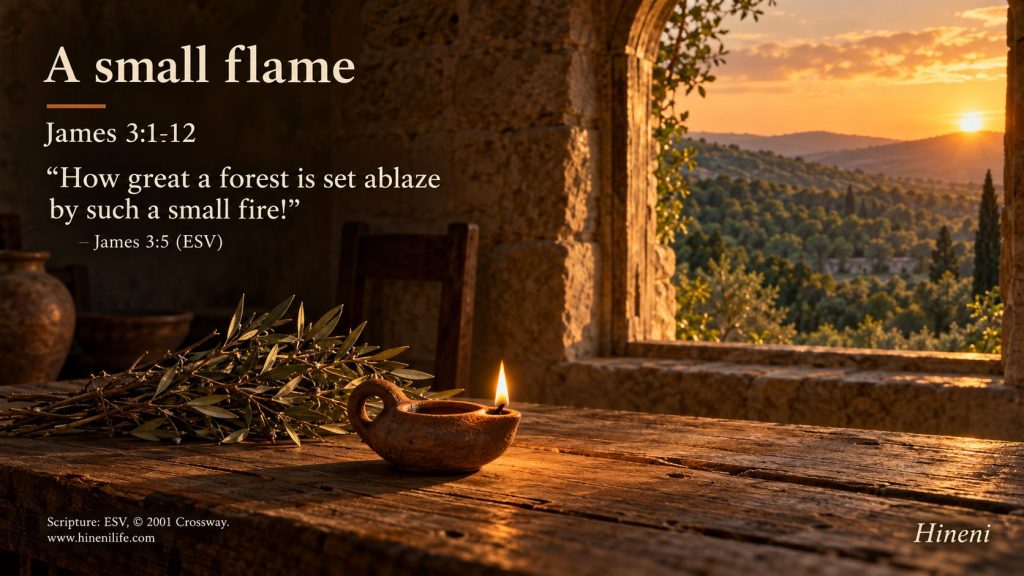
The wildfire (vv. 5-6): A tiny spark can ignite a great forest fire. One careless statement, an angry reaction, or a word spoken to wound someone can destroy trust that took years to build.
Words are never merely sounds that disappear after we speak them. They can encourage or discourage, restore or damage, heal or wound. Repeated patterns of speech also shape our character and relationships.
James warns us that the tongue can become a source of great destruction. That is why we must not treat careless speech as a small matter.
Before speaking, I need to ask myself: Will these words build up, or will they cause unnecessary harm? Am I speaking in love and truth, or simply reacting to what I feel?
The Human Impossibility: Who Can Tame the Tongue?
“But no one is able to tame the tongue. It is a restless evil, full of deadly poison.”
– James 3:8, ESV
James observes that human beings have learned to tame and control many kinds of creatures, yet no human being can tame the tongue.
This is a sobering statement. James is exposing the depth of our problem, not telling us to give up trying to speak rightly.
We often depend on our intelligence, experience, self-discipline, or ability to analyze a situation. We may even use our quick thinking to justify our words, defend ourselves, or win an argument. Yet, when our emotions rise, the words we thought we could control may escape before we have considered their consequences.
How often do we regret something we said moments after saying it?
The problem is deeper than a lack of vocabulary or communication skills. Our speech is connected to the desires, pride, anger, fears, and attitudes within us.
I cannot transform my heart through willpower alone. I need God’s transforming work within me.
James’s warning should bring us to humility and dependence on God. As believers, we must surrender our speech to the Lord and depend on the Holy Spirit to produce self-control in us (Galatians 5:22-23). This does not remove our responsibility to pause, listen, repent, and practise restraint. Rather, we do these things while depending on His grace instead of trusting in our own strength.
The first step toward victory is to stop pretending that we can manage this area of life without God’s help.
When the Same Mouth Blesses and Wounds
“With it we bless our Lord and Father, and with it we curse people who are made in the likeness of God. From the same mouth come blessing and cursing. My brothers, these things ought not to be so.”
– James 3:9-10, ESV
James now exposes one of the deepest contradictions in our spiritual lives.
We use our mouths to praise God in worship and prayer. Yet the same mouths may be used to insult, criticize, condemn, or belittle people who are made in God’s image.
How can we honour the Creator while treating His image-bearers with contempt?
James reinforces his point through illustrations from nature. A spring should not produce both fresh and bitter water from the same opening. A fig tree does not bear olives, and a grapevine does not bear figs (vv. 11-12).
His point is clear: our speech should be consistent with the faith we profess. A life that continually produces bitterness, cruelty, and destructive words reveals a heart that needs God’s transforming work.
This does not mean that a single failure proves someone has no genuine faith. James has already acknowledged that we all stumble. But neither should we excuse a continuing pattern of harmful speech as though it were unimportant.
When my mouth repeatedly produces anger, contempt, gossip, or harsh criticism, I must not merely try to improve my outward behaviour. I need to bring the condition of my heart before God and allow His Word to correct me.
What Is Happening in My Heart?
This passage brings me to some personal questions.
- When I feel the urge to speak, explain myself, or broadcast my opinions, can I pause and listen instead? Not every thought needs to be expressed, and not every disagreement requires an immediate response.
- When I am angry or corrected, do I depend on my own strength, or do I surrender my reaction to God? Spiritual maturity is revealed not only by what I say in peaceful moments but also by how I respond under pressure.
- Do I remember that the person I am criticizing is made in God’s image? Even when correction is necessary, it must not become an excuse for contempt or humiliation.
- Does my speech agree with the faith I profess? If I praise God with my mouth but repeatedly wound others with it, I need to take that contradiction seriously.
I cannot change my heart merely by promising to speak less or by trying harder to control every word. I need the Lord to transform what is within me. As He works in me, I must learn to pause before reacting, listen before answering, speak truth with love, and remain silent when silence is wiser.
The goal is not simply to become a quiet person. It is to become a person whose speech is increasingly governed by the wisdom, love, and self-control that come from God.
Lord Jesus, Your Word exposes how often my speech fails to reflect Your character. Forgive me for careless, impulsive, harsh, and destructive words. Forgive me for praising You with my mouth while wounding people who are made in Your image.
I confess that I cannot transform my heart through my own strength. Holy Spirit, work deeply within me. Help me to pause before speaking, to listen with humility, and to surrender my anger, pride, and desire to defend myself. Set a guard over my mouth and teach me to speak what is true, gracious, and helpful.
Let my words bring encouragement rather than discouragement, healing rather than hurt, and peace rather than unnecessary conflict. May my speech increasingly reflect the faith I profess and the character of Christ whom I follow.
In Jesus’ name, Amen.
Hineni