

9 August 2026
A Thought from My Personal Meditation on Exodus 26:7–14
Protecting What God Has Placed Within
As I continued my meditation through Exodus 26, I came to verses 7–14, where God gives Moses further instructions concerning the coverings of the Tabernacle.
In Exodus 26:1–6, we saw the beautiful inner curtains of the Tabernacle—fine twisted linen, blue, purple and scarlet yarn, with cherubim skillfully woven into them.
Now, beginning in verse 7, God gives instructions for additional coverings.
One thought particularly caught my attention:
“God did not leave what was precious within exposed. He provided coverings over it.”
The Coverings of the Tabernacle

Exodus 26:7 says:
“You shall also make curtains of goats’ hair to be a tent over the tabernacle.”
– Exodus 26:7 (ESV)
God commanded Moses to make eleven curtains of goat hair.
These curtains were larger than the beautiful inner linen curtains described in verses 1–6. They were arranged in groups and joined together with loops and clasps so that they formed a covering over the Tabernacle.
Then verse 14 says:
“And you shall make for the tent a covering of tanned rams’ skins and a covering of goatskins on top.”
– Exodus 26:14 (ESV)
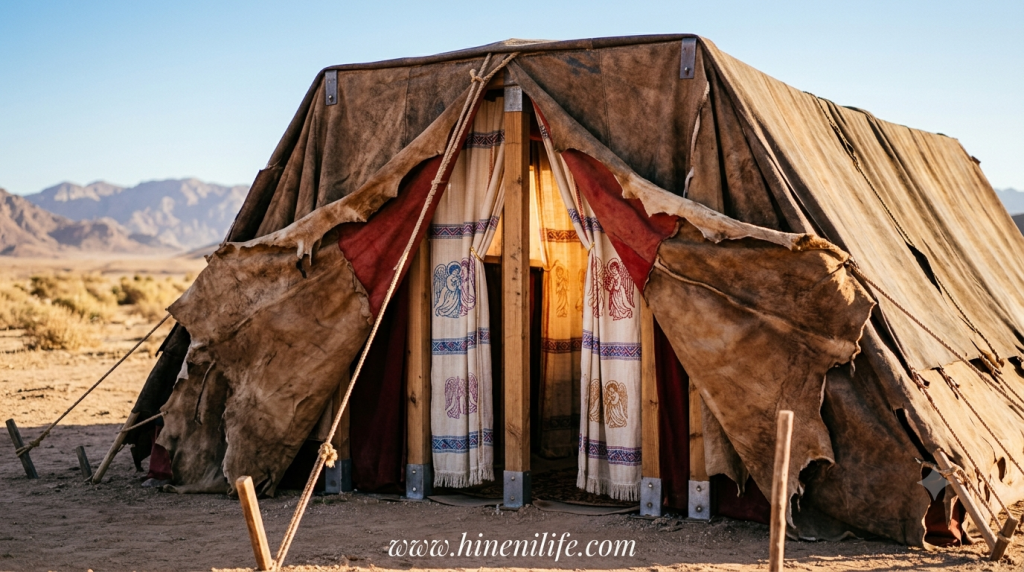
Therefore, the Tabernacle had several layers of covering. The beautiful linen curtains were on the inside. The goat-hair curtains were placed over them. Then came the coverings of rams’ skins and goatskins.
The beautiful inner curtains were therefore not exposed directly to the outside. They were covered. They were protected.
This is an important detail when we read Exodus 26. What was most beautiful was not necessarily what was most visible from the outside. The outer covering was what people would see. The beautiful linen, the colours and the cherubim were within.
And this led me to think about our own lives.
What Is Happening Within Us?
The Tabernacle was the place where God dwelt among His people.
The New Testament gives us an astonishing truth concerning believers:
“Do you not know that you are God’s temple and that God’s Spirit dwells in you?”
– 1 Corinthians 3:16 (ESV)
The Holy Spirit dwells within the believer. Therefore, there is something precious happening within us.
Our relationship with Christ is precious. Our faith is precious. Our love for God is precious. Our desire for holiness is precious. The work that God is doing in our hearts is precious.
But we live in a world that constantly presses against our spiritual life. There are temptations. There are distractions. There are pleasures. There are anxieties. There are worldly values that can slowly influence our hearts.
Sometimes the pressure is obvious. But very often, it happens gradually. A small compromise. A little neglect of prayer. A little less interest in God’s Word. A little more attachment to worldly things. A little bitterness that we refuse to surrender. A little pride that we allow to remain.
And slowly, something that was once sensitive to God can become hardened.
This made me ask myself: “What am I doing to protect what God is building within me?”
The Covering Does Not Create the Beauty
There is another important thought here.
The outer covering did not create the beauty of the inner curtains. The beauty was already there. The covering protected what was already there.
In the same way, our spiritual disciplines do not replace the work of Christ.
Prayer does not save us. Bible reading does not save us. Fasting does not save us. Christian activities do not save us. Christ saves us.
But once Christ has begun His work in us, we are called to walk carefully with Him.
Paul says:
“Work out your own salvation with fear and trembling.”
– Philippians 2:12 (ESV)
And immediately he gives us the foundation:
“For it is God who works in you, both to will and to work for his good pleasure.”
– Philippians 2:13 (ESV)
God works within us, and we respond to Him in obedience.
How Do We Guard Our Inner Life?
The Bible gives us practical guidance.
Through God’s Word
Jesus prayed:
“Sanctify them in the truth; your word is truth.”
– John 17:17 (ESV)
The Word of God protects our thinking. Every day we hear voices telling us what is valuable, what is acceptable, what is successful and what will make us happy. But God’s Word gives us a different standard.
So we should ask ourselves: “What is shaping my thinking every day—the Word of God or the voice of the world?”
Through Prayer
Jesus said:
“Watch and pray that you may not enter into temptation.”
– Matthew 26:41 (ESV)
Prayer is not merely about asking God for things. Prayer keeps us connected to God. It reminds us of our dependence upon Him. It helps us recognize temptation and gives us the strength to respond rightly.
By Abiding in Christ
Jesus said:
“Abide in me, and I in you.”
– John 15:4 (ESV)
This is perhaps the most important principle. We cannot preserve our spiritual life merely through human determination. A branch cannot live independently of the vine. Our spiritual life depends upon our continuing relationship with Christ.
The Christian life is therefore not simply: “Try harder.”
It is: “Abide deeper.”

By Walking in the Spirit
Paul says:
“Walk by the Spirit, and you will not gratify the desires of the flesh.”
– Galatians 5:16 (ESV)
The Holy Spirit who dwells within us also leads us. We need to learn to recognize His conviction and respond in obedience. When He tells us to forgive, we forgive. When He shows us something that must be surrendered, we surrender it. When He leads us away from temptation, we follow.
The Outer Person and the Inner Person
While meditating on this passage, another Scripture came strongly to my mind.
Paul writes:
“Though our outer self is wasting away, our inner self is being renewed day by day.”
– 2 Corinthians 4:16 (ESV)
What a beautiful truth!
Our outward life is temporary. Our bodies become weaker. Our circumstances change. Our earthly possessions pass away. The world around us changes. But God is doing something deeper. He is renewing the inner person day by day.
Paul also says:
“We have this treasure in jars of clay.”
– 2 Corinthians 4:7 (ESV)
There is something precious inside an ordinary and fragile vessel. The vessel may be weak. The vessel may suffer. The vessel may grow old. But the treasure remains precious.
The Pressure From Outside
This brings me back to the picture of the Tabernacle. The outer coverings were exposed to the environment around them. In the wilderness, the Tabernacle needed coverings that could protect what was within.
Likewise, we live in a world that constantly puts pressure upon our spiritual lives. We cannot always control what happens around us. We cannot prevent every temptation from appearing. We cannot stop every difficult circumstance. We cannot control what other people say about us.
But we can decide what we allow those things to do within us.
A temptation may come, but we don’t have to welcome it. A hurt may come, but we don’t have to allow it to become bitterness. A disappointment may come, but we don’t have to allow it to destroy our faith. A worldly attraction may come, but we don’t have to surrender our heart to it.
This is why spiritual watchfulness is so important.
What Are We Allowing Inside?
Perhaps one of the most important questions for a Christian is not:
“What do other people see in me?”
but:
“What is happening inside me?”
What happens in my heart when nobody sees me? What do I think about when I am alone? What do I desire? What am I secretly holding on to? What am I unwilling to surrender to God? What is slowly taking the place that belongs to Christ?
These questions are not meant to condemn us. They are an invitation to come honestly before God. The Holy Spirit is the One who brings conviction. Our responsibility is to allow the light of God’s Word to examine us.
David prayed:
“Search me, O God, and know my heart! Try me and know my thoughts!”
– Psalm 139:23 (ESV)
That should also be our prayer. Not pretending. Not hiding. Not comparing ourselves with others. But allowing God to search our hearts.
Christ and the Hidden Glory
There is also a beautiful connection that came to my mind concerning Christ.
Isaiah 53:2 says of the suffering Servant:
“He had no form or majesty that we should look at him, and no beauty that we should desire him.”
– Isaiah 53:2 (ESV)
This does not necessarily mean that Jesus was physically unattractive. Rather, He did not come with the outward splendour and royal majesty that people expected from the Messiah. He appeared ordinary. He was despised and rejected.
Yet John tells us:
“The Word became flesh and dwelt among us, and we have seen his glory.”
– John 1:14 (ESV)
The glory was there, even though many did not recognize it. The Tabernacle gives us a picture of something precious within, covered by outer layers. Christ gives us the greater reality.
Divine glory was present in human flesh.
Many people saw only what was outward. But those who came to Jesus in faith began to see who He truly was.
I would not say that the ram skins or goatskins specifically represent the physical appearance of Jesus, because Scripture does not give us that interpretation. But the broader biblical picture is beautiful: The Tabernacle pointed toward God’s dwelling presence, and in Christ, God Himself came to dwell among humanity.
The Ram and the Sacrifice
The rams’ skins mentioned in Exodus 26:14 also remind us of an important biblical association.
In Genesis 22, when Abraham was prepared to offer Isaac, God provided a ram:
“And Abraham went and took the ram and offered it up as a burnt offering instead of his son.”
– Genesis 22:13 (ESV)
The ram became a substitute. Later, Isaiah describes the suffering Servant as one who was led like a lamb to the slaughter. And in the New Testament, John the Baptist identifies Jesus:
“Behold, the Lamb of God, who takes away the sin of the world!”
– John 1:29 (ESV)
Therefore, while we should not claim that the ram-skin covering itself is explicitly a symbol of Christ, the sacrificial associations of the ram throughout Scripture naturally draw our thoughts toward the greater sacrifice of Christ.
Jesus is our substitute. Jesus is our righteousness. Jesus is the One through whom we have access to God. And ultimately, our security is not in our ability to protect ourselves but in Him.
Protecting the Beauty Within
So what can we practically do?
We can guard what enters our minds. We can be careful about what we watch and listen to. We can spend time in God’s Word. We can maintain a life of prayer. We can respond quickly when the Holy Spirit convicts us. We can confess sin instead of hiding it. We can forgive instead of allowing bitterness to grow. We can flee from situations that repeatedly lead us into temptation. We can choose fellowship with believers who encourage us toward Christ.
And above all: We can abide in Christ.
The world will continue to press against us. The outer person will continue to grow weaker. But our inner person can be renewed every day.
The question is not whether pressure will come. The question is what that pressure will produce within us.
Will it make us bitter or more dependent upon Christ? Will it make us worldly or more heavenly-minded? Will it weaken our faith or drive us deeper into God’s presence?
May the beauty that God is creating within us never be neglected. May we guard it. May we nourish it. May we surrender it continually to Christ. And may our outward life eventually reveal what Christ is doing within us.
“Though our outer self is wasting away, our inner self is being renewed day by day.”
– 2 Corinthians 4:16 (ESV)
That is my prayer for myself: “Lord, while everything around me is changing, keep renewing what You have placed within me.”
Hineni