
14 August 2026
A Meditation on Exodus 27:20–21
Keep the Lamp Burning
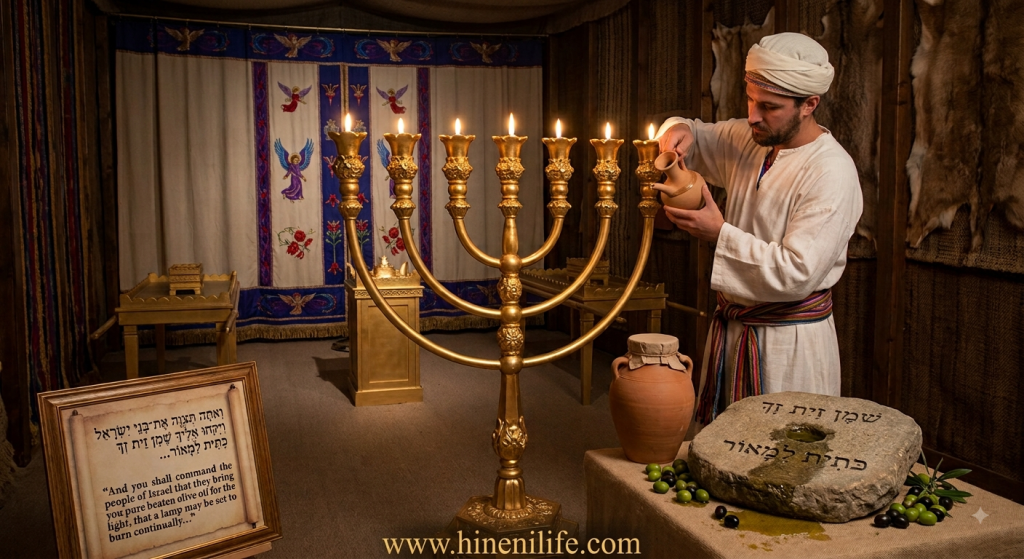
As I come to the final two verses of Exodus 27, I notice a beautiful transition.
The earlier verses described the altar and the courtyard—the physical structure and arrangement of the Tabernacle. But in verses 20–21, our attention moves towards something that had to happen continually: the lamp had to keep burning before the LORD.
God instructed Moses:
“You shall command the people of Israel that they bring to you pure beaten olive oil for the light, that a lamp may continually be set up to burn.”
– Exodus 27:20 (ESV)
And then:
“In the tent of meeting, outside the veil that is before the testimony, Aaron and his sons shall tend it from evening to morning before the LORD.”
– Exodus 27:21 (ESV)
There are two responsibilities here that caught my attention:
The people had to bring the oil. Aaron and his sons had to tend the lamp.
And the purpose was: The light had to continue burning before the LORD.
From Construction to Continual Worship
Throughout Exodus 25–27, God has been giving Moses extremely detailed instructions about the Tabernacle. The altar had to be made in a particular way. The courtyard had specific dimensions. The curtains, pillars and bases had to be prepared according to God’s instructions.
But after all these details, God now speaks about the oil and the lamp. This reminds me that the Tabernacle was not merely a beautiful structure. It was a place of worship and communion with God.
The purpose of constructing the Tabernacle was not simply to complete a building. God desired to dwell among His people. And therefore, the worship within it had to continue.
The lamp was not something that was lit occasionally. It was to burn continually before the LORD.
This makes me think about my own Christian life. Is my relationship with God something that happens only at particular times? Or is it a continual relationship?
“Pure Beaten Olive Oil”
The expression “pure beaten olive oil” immediately caught my attention.
The oil used for the lamp was to be pure olive oil prepared from the olives. In the traditional process, olives were crushed or beaten so that the oil could be released from the fruit.
The image is striking: The olive undergoes a process before the oil is released.
I want to be careful here. Exodus 27 does not explicitly say that the crushing of the olives represents suffering, persecution or spiritual purification. So we should not treat that as the direct interpretation of the verse. But it gives us a meaningful picture for Christian reflection.
Our lives also pass through processes that we would not necessarily choose. There are disappointments. Pressure. Waiting. Trials. Misunderstandings. Persecution. Loss. Difficult relationships. Unanswered questions.
And sometimes we ask: “Why is God allowing me to go through this?”
Yet God can use even these circumstances to work on our character.
James writes:
“for you know that the testing of your faith produces steadfastness.”
– James 1:3 (ESV)
And Paul says:
“Though our outer self is wasting away, our inner self is being renewed day by day.”
– 2 Corinthians 4:16 (ESV)
The goal is not suffering for the sake of suffering. The goal is transformation. God desires to form the character of Christ in us.
The Light Must Continue Burning
The oil was provided for the light. And the instruction was that the lamp should continually burn.
This is where the passage becomes especially meaningful for me.
Jesus said:
“I am the light of the world. Whoever follows me will not walk in darkness, but will have the light of life.”
– John 8:12 (ESV)
Jesus is the true Light. John says:
“The light shines in the darkness, and the darkness has not overcome it.”
– John 1:5 (ESV)
Therefore, when I think about the lamp in the Tabernacle, I am reminded of Christ—the One who brings light into our darkness. But Jesus also said something remarkable to His disciples:
“You are the light of the world.”
– Matthew 5:14 (ESV)
How can both be true? Because Christ is the source of our light. We do not produce spiritual light independently. Our calling is to reflect the light of Christ.
Like the Moon Reflecting the Sun
I find the moon to be a helpful illustration here. The moon does not produce its own light. It reflects the light of the sun.
In the same way, the Christian life should reflect Christ. When people interact with us, they should gradually see something of Jesus: His love. His patience. His humility. His forgiveness. His truthfulness. His compassion. His holiness. His willingness to surrender Himself for others.
The question is therefore not merely: “Do people know that I am a Christian?”
A deeper question is: “Can people see something of Christ through the way I live?”
The Light Is Tested in Darkness
Exodus 27:21 says that Aaron and his sons were to tend the lamp “from evening to morning.” The lamp was especially necessary when there was darkness.
That gives us another beautiful spiritual picture. It is easy to appear joyful when everything is going well. It is easy to speak about faith when life is comfortable. But what happens when darkness comes?
When someone treats me unfairly, how do I respond? When I am misunderstood, do I remain gentle? When I am disappointed, do I continue trusting God? When someone hurts me, can I forgive? When I am under pressure, does Christ’s character remain visible? When I don’t receive what I expected, do I still surrender to God?
Dark seasons reveal what is actually burning within us.
Our faith is not demonstrated only by what we say during peaceful moments. It becomes visible through our responses when life becomes difficult.
Continual Fellowship With God
There is another important lesson in the word “continually.” The lamp was not supposed to burn only on special occasions.
And our relationship with God cannot be limited to:
- Sunday worship
- Prayer meetings
- Retreats
- Bible studies
- Special Christian gatherings
Those are valuable, but Christianity is a daily walk with Christ.
Paul says:
“But I say, walk by the Spirit, and you will not gratify the desires of the flesh.”
– Galatians 5:16 (ESV)
Notice the word walk. It speaks of an ongoing journey. Not one spiritual experience. Not one prayer. Not one retreat. Not one decision. But a continuing relationship with God.
Every day I need to surrender my thoughts, desires, decisions and actions to Him.
The Responsibility of the People and the Priests
Something else caught my attention in these verses. The people were instructed to bring the oil. Aaron and his sons were responsible for tending the lamp. Everyone therefore had a part to play in the worship of God.
This also reminds us that our relationship with God cannot be treated as somebody else’s responsibility. In the New Testament, we are not dependent upon a special priesthood to maintain our personal relationship with God. Through Christ, we have access to God.
Peter describes believers as:
“a royal priesthood, a holy nation, a people for his own possession…”
– 1 Peter 2:9 (ESV)
Therefore, I cannot simply say: “My pastor will take care of my spiritual life.” “My church will keep me close to God.” “My Bible study group will keep my faith alive.”
These things can encourage and strengthen us, but I have a personal responsibility to walk with God. I must seek Him. I must read His Word. I must pray. I must listen when He corrects me. I must repent when I fall. I must obey what He shows me.
What Does “Pure” Make Me Ask?
The oil had to be pure. That word makes me examine my own life.
Is my relationship with God genuine? Am I following Christ because I truly love Him? Or am I simply maintaining an outward Christian appearance? Do I pray only when I need something? Do I read the Bible only because it is part of my routine? Do I worship God publicly while living differently privately?
God is not looking merely at the appearance. He looks at the heart.
David prayed:
“Create in me a clean heart, O God, and renew a right spirit within me.”
– Psalm 51:10 (ESV)
That is the kind of prayer I need. Lord, make my heart pure. Not merely my appearance. Not merely my words. Not merely my religious activities. My heart.
What About Suffering?
There is a thought here that needs careful balance. The crushing of olives can remind us of the pressures through which God sometimes shapes us. But we should never conclude that every difficulty is God’s punishment or that a person who is suffering must have a spiritual problem.
The story of Job teaches us otherwise. Job suffered deeply, yet the Bible does not present his suffering as the result of some hidden personal sin. At the same time, Scripture does teach that followers of Christ should expect difficulties.
Paul writes:
“Indeed, all who desire to live a godly life in Christ Jesus will be persecuted.”
– 2 Timothy 3:12 (ESV)
Therefore, the right question is not: “If my life is difficult, does that mean God is angry with me?” Nor is it: “If my life is comfortable, does that mean everything is spiritually perfect?”
Instead: “Am I faithful to God in whatever season He has allowed me to walk through?” Whether in abundance or need. Whether in peace or difficulty. Whether in joy or sorrow. Keep the lamp burning.
The Narrow Way
Jesus said:
“Enter by the narrow gate. For the gate is wide and the way is easy that leads to destruction…”
– Matthew 7:13–14 (ESV)
Following Christ is not always the easiest path. There will be times when obedience costs us something. There will be times when we have to say no to our desires. There will be times when forgiveness is difficult. There will be times when remaining truthful costs us an opportunity. There will be times when we must surrender our ambitions to God’s will.
But the Christian life is not about choosing the easiest road. It is about choosing Christ. And as we walk with Him, He transforms us.
The Light Should Be Visible to Others
Jesus concludes His teaching about being the light of the world by saying:
“In the same way, let your light shine before others, so that they may see your good works and give glory to your Father who is in heaven.”
– Matthew 5:16 (ESV)
Notice the purpose. Not: “Let people admire you.” But: “Give glory to your Father.”
Our good works are not meant to make us famous. Our transformed life should point people towards Jesus. When someone is unfair to me and I respond with grace, that can point to Christ. When someone hurts me and I forgive, that can point to Christ. When I refuse dishonesty even when it costs me, that can point to Christ. When I remain peaceful in circumstances that could make me bitter, that can point to Christ. When I serve someone without expecting anything in return, that can point to Christ.
The light is not about making ourselves visible. It is about making Christ visible.
Is My Lamp Still Burning?
Perhaps this is the most important question I take from Exodus 27:20–21.
Not: “Did I once experience God?” Not: “Did I once pray sincerely?” Not: “Did I once surrender my life to Christ?”
But: “Am I walking with Jesus today?”
Is His Word shaping my decisions today? Is His Spirit guiding my thoughts today? Is His character visible in my reactions today? Am I still willing to surrender today? Is the light still burning?
A Personal Reflection
As I stand before the mirror of God’s Word, I want to ask myself:
Am I maintaining continual fellowship with God?
Is there purity in my relationship with Him?
When difficulties come, am I allowing God to shape me through them?
When people hurt me, do they see my anger or Christ’s character?
When I am under pressure, does my light continue to shine?
Am I living for Christ only during Christian activities, or throughout my ordinary daily life?
These questions are not meant for judging someone else. They are questions I need to ask myself. Because the purpose of God’s Word is not merely to give me information. It is to reveal my condition and lead me towards repentance, surrender and transformation.
Keep the Lamp Burning
Exodus 27 began with the altar—a place of sacrifice. Then we saw the courtyard—a boundary and a way of approach. And now the chapter ends with the lamp—light that must continue burning.
There is a beautiful progression:
Come to the altar. Surrender yourself to God.
Enter through the way God has provided. Come through Jesus Christ.
Live within the boundaries of holiness. Do not allow the world to control your heart.
Keep the lamp burning. Walk continually with Christ.
Let His light shine through you. So that others may see Him.
The Christian life is not a Sunday experience. It is not a retreat experience. It is not something we switch on during prayer time and switch off when we leave the church. It is a continual walk with Christ.
There will be seasons of sunshine. There will be seasons of darkness. There will be times of abundance. There will be times of pressure. But whatever the season:
Keep the lamp burning.
Let Christ remain the source of your light. Let His Word guide you. Let His Spirit lead you. Let His character be formed in you. And let the people around you see something of Jesus through your life.
“Let your light shine before others, so that they may see your good works and give glory to your Father who is in heaven.”
– Matthew 5:16 (ESV)
Lord, keep my lamp burning before You. The purpose of the oil was not merely to go through the crushing process. It was to produce the light. And perhaps the purpose of some of the difficult seasons in our lives is not merely to make us endure them, but to allow the character and light of Christ to shine more clearly through us. May my life continue to burn before the LORD—not occasionally, but continually.
Hineni