

Do Not Take His Presence Casually
Exodus 30:17-21
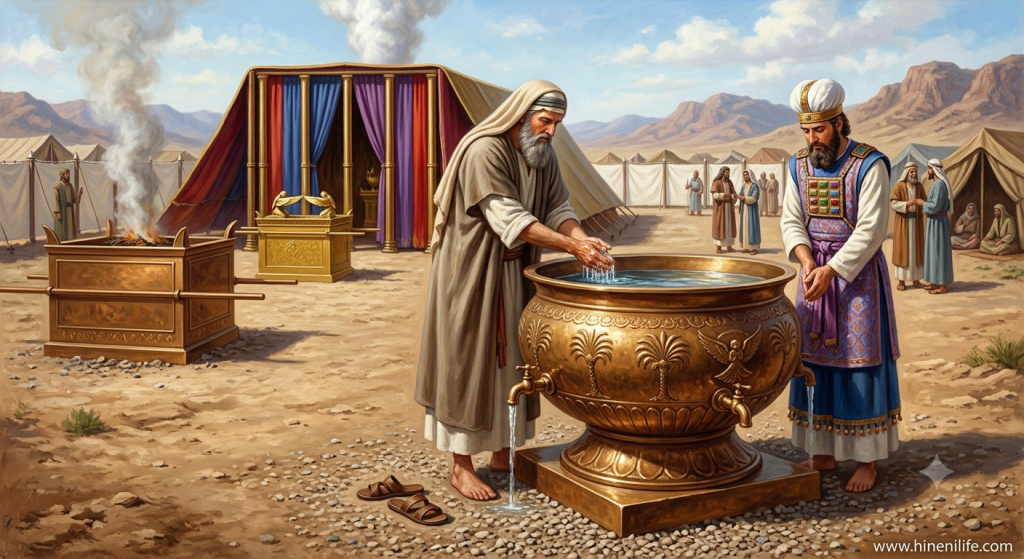
There is something very striking about the bronze basin described in Exodus 30:17-21. God commanded Moses to make a bronze basin with a bronze stand and place it between the Tent of Meeting and the altar. Aaron and his sons were to wash their hands and feet with the water from it whenever they entered the Tent of Meeting or approached the altar to minister before the LORD.
The instruction is repeated in verses 19, 20 and 21: they were to wash their hands and feet. And twice, in verses 20 and 21, God gives the serious reason: “so that they may not die.”
The repetition makes the seriousness of the instruction difficult to miss.
God was teaching His priests something about approaching His presence.
His presence was holy. And therefore, it could never be treated casually.
Have I Become Too Casual?
As I meditated on this passage, I began to think about my own life.
There have been times when I went to church with genuine reverence. I came prepared to worship, to listen to God’s Word, to pray and to meet with God’s people.
But there have also been days when I went casually.
I have participated in worship casually. I have listened to the Word casually. And there have even been occasions when I have taken part in the Lord’s Table without the reverence that such a holy remembrance deserves.
I don’t say this to condemn myself. I say it because this passage made me stop and examine myself.
Have I become too familiar with the things that are holy?
The priests in Exodus were not outsiders. They were God’s appointed priests. They had been called. They had been consecrated. They had been set apart for service.
Yet even they were not permitted to approach the holy things carelessly.
That challenged me.
Because sometimes I can think, “I belong to God. I know Christ. I have been redeemed. I can come to God at any time.”
And that is gloriously true.
But the privilege of access to God should never produce casualness toward God. It should produce deeper reverence.
We Have Access – But We Must Never Become Careless
As Christians, we live under a greater privilege than the priests of the Old Covenant.
Through Jesus Christ, we can approach God with confidence.
Hebrews 10:19-22 speaks of having confidence to enter God’s presence through Jesus and draws our attention to having our hearts cleansed and our bodies washed with pure water.
The gospel does not tell me to stay far away from God because I am unclean. It tells me that Christ has made a way for me to draw near.
That is grace.
But grace does not make God’s holiness less serious. In fact, grace should make me more reverent.
I don’t approach God because I am good enough. I approach Him because Jesus is sufficient.
I don’t come because I have perfectly cleansed myself. I come because Christ has provided the cleansing I could never provide for myself.
And precisely because such access was purchased at such a cost, I should never treat it as something ordinary.
“Wash Their Hands and Their Feet”
The priests were instructed to wash their hands and feet.
The passage does not tell us to create a symbolic meaning for every part of the body. But as I reflected on it, the picture itself challenged me.
My hands are constantly involved in life. My feet take me through this world.
Every day I see things, hear things, read things, speak things and do things.
I live in this world, but I am not supposed to allow everything in this world to shape me.
The world constantly presses its influence upon me.
My thoughts can become contaminated. My words can become careless. My attitudes can become wrong.
Anger can rise within me. Pride can quietly enter. Wrong desires can take root.
Sometimes I say something I should not have said. Sometimes I do something I should not have done. Sometimes I realize only later that my heart has wandered.
And that is why this prayer becomes very personal for me:
“Lord, cleanse me.”
Not because I believe that I can make myself worthy to approach God. But because I recognize how much I need the cleansing that comes from Christ.
“If We Say We Have No Sin…”
This is where 1 John 1 speaks directly to my heart.
John says that if we claim to have no sin, we deceive ourselves. But he immediately gives us hope:
“The blood of Jesus his Son cleanses us from all sin.”
And then he says:
“If we confess our sins, he is faithful and just to forgive us our sins and to cleanse us from all unrighteousness.”
– 1 John 1:7, 1:9 ESV
What a beautiful balance.
The Christian life is not pretending that we are already perfectly clean. Neither is it living as though sin does not matter.
It is coming honestly before God.
“Father, this is what I have done. This is where I have failed. This is what is in my heart. Cleanse me.”
Confession is not a ritual that I must perform mechanically before every prayer or every Bible reading.
Rather, it is the honest posture of a believer who knows that he still needs the grace of God every day.
I need Christ’s cleansing – not because His finished work is insufficient, but precisely because His finished work is sufficient and I continually need to live in the reality of that grace.
David’s Prayer Becomes My Prayer
While meditating on this, I was reminded of David’s prayer in Psalm 51.
After acknowledging his sin, David prayed:
“Wash me thoroughly from my iniquity, and cleanse me from my sin!”
And again:
“Purge me with hyssop, and I shall be clean; wash me, and I shall be whiter than snow.”
– Psalm 51:2, 51:7 ESV
David wasn’t asking God merely to remove the consequences of his sin. He wanted God to deal with the sin itself.
That is something I need to pray too.
Sometimes I don’t merely need God to change my circumstances. I need Him to change me.
If anger has become part of my character, I need to say: “Lord, wash me.”
If pride has entered my heart: “Lord, cleanse me.”
If my thoughts have become impure: “Lord, cleanse me.”
If my words have wounded someone: “Lord, forgive me and change me.”
If I have become spiritually careless: “Lord, restore my reverence for You.”
Called and Consecrated – Yet Still Needing Cleansing
There is another connection that makes this passage especially meaningful in our Exodus journey.
We have already seen that Aaron and his sons were called and consecrated for God’s service. But Exodus 30 now reminds us that being consecrated for service did not mean they could become careless in God’s presence.
That challenges me personally.
I can say: “Lord, use me.”
But perhaps I also need to say: “Lord, cleanse me.”
I can ask: “Lord, give me opportunities to serve You.”
But I must also ask: “Lord, keep my heart close to You while I serve.”
It is possible to become very interested in doing something for God while slowly becoming careless about being with God.
And I don’t want that.
I don’t want ministry without fellowship. I don’t want activity without intimacy. I don’t want to handle holy things while my heart becomes casual toward the Holy One.
What About Sunday Worship?
This passage brought me back again to Sunday worship.
Sometimes we enter church thinking about everything except God. We may be tired from the previous week. Our minds may be occupied with work, family, money, responsibilities, phones and countless other things.
And before we realize it, we are physically present but spiritually distracted.
I have experienced this myself.
So perhaps before entering worship, I need to pause and say:
“Lord, I am coming before You. Quiet my heart. Forgive my sins. Remove what is distracting me. Help me to worship You with reverence.”
Not because the church building is equivalent to the tabernacle.
Not because I must perform an Old Testament cleansing ritual.
And certainly not because Christ’s blood needs to be applied again as though His sacrifice were incomplete.
Rather, because the God whom I am worshipping is holy, and the privilege of gathering in His name should never become routine.
The Lord’s Table especially deserves such self-examination.
Paul’s teaching in 1 Corinthians 11 calls believers to examine themselves before participating.
That does not mean staying away because we are imperfect. If perfection were the requirement, none of us could come.
It means coming honestly, repentantly and reverently, remembering what Christ has done for us.
The Basin Points Beyond the Basin
I don’t want to claim that the bronze basin itself is a direct symbol of Jesus’ blood. Exodus 30 does not explicitly make that identification.
But the Biblical story develops the theme of cleansing until we see its fullness in Christ.
The priests needed ceremonial washing. We need something far deeper. We need cleansing from sin.
And the New Testament points us to Jesus Christ.
His blood cleanses us. His sacrifice is sufficient. His finished work gives us access to God.
Hebrews tells us that because of what Christ has accomplished, we can draw near to God with confidence.
So today I don’t stand outside the presence of God wondering whether I have done enough to deserve entrance. Christ has opened the way.
But that confidence should never become carelessness.
It should make me bow lower. It should make me more grateful. It should make me more sensitive to sin. It should make me more eager to confess. It should make me more determined to walk in holiness.
“Lord, Cleanse Me”
Perhaps that is what this passage is saying to my heart today.
Not: “Stay away from God because you are unclean.”
But: “Do not become casual about the God who has made a way for you to come near.”
I have been redeemed. I have been given access through Christ. I have been called to belong to Him. I have been given the privilege of serving Him.
But every day I still need His transforming grace.
So before I say: “Here I am, Lord. Use me,”
perhaps I should first say: “Here I am, Lord. Cleanse me.”
Before I ask Him to use my hands, I can ask Him to cleanse my hands.
Before I ask Him to direct my feet, I can ask Him to keep my feet walking in His ways.
Before I ask Him to use my words, I can ask Him to purify my heart.
Before I enter worship, I can pause.
Before I open the Bible, I can pause.
Before I pray, I can pause.
Not to perform a ritual. Not to earn God’s acceptance.
But to remember who I am approaching and whose grace has made that approach possible.
The holy God has invited me near. That is grace.
Jesus has opened the way. That is grace.
His blood cleanses me from sin. That is grace.
And because of that grace, I don’t want to become casual.
I want to become more reverent. More repentant. More dependent. More aware of His presence. More careful about how I live.
And more willing to pray:
“Lord, cleanse me daily. Wash me from my sin. Purify my heart. Correct me where I have become careless. Restore my reverence for You. And let my service flow from fellowship with You.”
Father, thank You for making a way for me to come near to You through Jesus Christ. Forgive me for the times I have become casual about Your presence, Your Word, worship, prayer and the things You have called holy. Forgive me for the times I have been more concerned about serving You than walking closely with You.
Lord, cleanse me. Where there is sin in me, show me. Where there is pride, humble me. Where there is anger, change me. Where there are wrong desires, purify me. Where I have become spiritually careless, awaken me again.
Thank You that I do not have to cleanse myself before I can come to You. Thank You that the blood of Jesus cleanses me from all sin. Help me to live every day in repentance, gratitude, reverence and dependence upon Your grace.
When I worship You, help me worship with reverence. When I read Your Word, help me listen with a humble heart. When I pray, help me remember that I am speaking to the holy God who has graciously invited me near. And when I serve You, let my service flow from fellowship with You.
Lord, here I am. Cleanse me. Shape me. Correct me. Teach me. Use me. Have Your way with me.
In Jesus’ name, Amen.
Hineni