
10 August 2026
A Thought from My Personal Meditation on Exodus 26:15–30
Built to Stand: The Framework of the Tabernacle
As I continued my meditation through Exodus 26, I came to verses 15–30. After describing the beautiful inner curtains and the coverings of the Tabernacle, God now gives Moses detailed instructions concerning something that may initially appear less significant—the boards and framework of the Tabernacle.
At first, these verses can feel like a long list of measurements, numbers, sockets, boards and bars.
But when we stop and look carefully, we begin to see something beautiful.
The curtains described earlier were beautiful. The coverings protected them. But underneath all of them was a framework that gave the Tabernacle its shape, stability and strength.
Without that framework, the curtains could not stand as a dwelling. And that immediately brought a spiritual question to my heart:
“What is giving my life its structure?”
The Tabernacle Needed a Framework
God commanded Moses:
“You shall make upright frames for the tabernacle of acacia wood.”
– Exodus 26:15 (ESV)
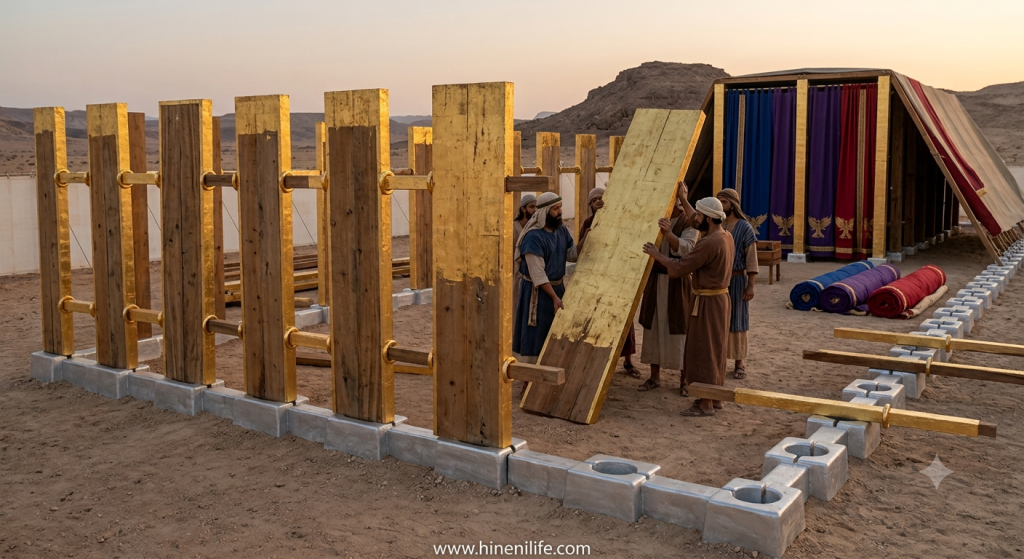
These were not simply decorative pieces. The boards formed the structural walls of the Tabernacle. The beautiful curtains were attached to and supported by this framework. The boards stood upright in silver sockets and were joined together with bars. Together, these individual pieces formed a stable structure.
The Tabernacle was not simply a collection of beautiful curtains lying in the wilderness. It was a carefully constructed dwelling.
The framework gave it:
- Shape
- Stability
- Strength
- Support
- Unity
The curtains needed something strong enough to support them. The coverings needed something beneath them. The entire dwelling needed a structure that could stand. And God gave Moses precise instructions for that structure.
The Boards Had to Stand Upright
The first description is significant. God says:
“You shall make upright frames for the tabernacle…”
– Exodus 26:15 (ESV)
The boards were designed to stand. They were not lying on the ground. They were not leaning against one another randomly. They were standing upright as part of a carefully designed structure.
This immediately reminds me of the repeated call in the New Testament for believers to stand firm.
Paul says:
“Therefore take up the whole armor of God, that you may be able to withstand in the evil day, and having done all, to stand firm.”
– Ephesians 6:13 (ESV)
The Christian life is not simply about beginning well. It is about continuing to stand.
There will be days of temptation. There will be days of disappointment. There will be days when prayers appear unanswered. There will be days when people misunderstand us. There will be days when our faith is tested.
The question is not whether pressure will come. The question is: “What will enable us to stand when it comes?”
The Boards Were the Supporting Framework
The beautiful curtains from Exodus 26:1–6 were made from fine twisted linen with blue, purple and scarlet yarn and cherubim skillfully woven into them. But those curtains needed a structure. The curtains could display beauty, but the boards provided the framework that enabled that beauty to stand.
This is an important spiritual picture.
A Christian life can have many beautiful outward expressions. We can worship. We can sing. We can serve. We can speak beautifully about God. We can have Bible knowledge. We can participate in ministry. But underneath all of this there must be a foundation that enables us to remain standing.
Jesus gave us a similar picture in Matthew 7.
“Everyone then who hears these words of mine and does them will be like a wise man who built his house on the rock.”
– Matthew 7:24 (ESV)
Notice that Jesus does not merely speak about hearing. He says: “hears these words of mine and does them.”
The foundation of a Christian life is not merely knowledge. It is a life built upon Christ and His Word.
The Boards Stood on Silver Sockets
The boards were not simply placed directly on the ground. They stood upon silver sockets. Exodus 26 repeatedly mentions these sockets. The boards had tenons that fitted into them, giving the structure a secure foundation.
This is where another interesting biblical connection appears. When we come to Exodus 30 and Exodus 38, we discover where the silver was associated with. The Israelites were required to give a half-shekel contribution in connection with the census.
Exodus 30:15 calls it a ransom for their lives. Then Exodus 38:25–28 records that the silver collected was used for the sockets and other structural components of the Tabernacle.
This is fascinating. The structure that supported the dwelling place was standing upon silver that was connected with ransom.
Now listen to Peter in the New Testament:
“Knowing that you were ransomed from the futile ways inherited from your forefathers, not with perishable things such as silver or gold, but with the precious blood of Christ.”
– 1 Peter 1:18–19 (ESV)
The Old Testament uses silver in connection with ransom. The New Testament takes us to something infinitely greater. Our redemption was not ultimately purchased with silver. It was purchased through the precious blood of Jesus Christ.
I would be careful here not to say that every individual silver socket directly represents the blood of Jesus. Scripture does not explicitly make that statement. But the broader biblical movement is unmistakable: ransom → redemption → Christ’s sacrifice. The Tabernacle points forward to the greater work that Christ would accomplish.
Many Boards, But One Dwelling
God gives detailed instructions about the number and arrangement of the boards. There were twenty boards on the south side. Twenty on the north. Six at the rear. Two additional boards at the corners. Each board had a specific place.
This is an important principle. God did not build the Tabernacle out of one enormous piece. He used many individual pieces. Yet all of them became one structure.
This provides a beautiful background for Paul’s teaching concerning the Church.
“For just as the body is one and has many members…”
– 1 Corinthians 12:12 (ESV)
And:
“Now you are the body of Christ and individually members of it.”
– 1 Corinthians 12:27 (ESV)
The Church is not made up of identical people. We have different backgrounds. Different gifts. Different personalities. Different responsibilities. Different ministries. Yet Christ brings us together into one body.
Every Board Had a Place
One thought particularly struck me while reading this passage. Every board had its place.
A board could not simply decide: “I don’t like where God has placed me. I want to stand somewhere else.” God had designed the structure.
This is a beautiful lesson for the Christian life. Sometimes we compare ourselves with other believers. We see someone preaching and think: “I wish I could do that.” We see someone leading worship. Someone teaching. Someone serving. Someone writing. Someone caring for people. And we may begin to think that our own role is insignificant.
But the Tabernacle reminds us: Every part has a place in God’s design.
Paul says:
“God arranged the members in the body, each one of them, as he chose.”
– 1 Corinthians 12:18 (ESV)
Your calling may not look like someone else’s. Your place may not be visible. But faithfulness is more important than visibility. The question is not: “Am I as important as someone else?” The question is: “Am I faithfully fulfilling the place God has given me?”
The Boards Were Joined Together
God then commands bars to connect the boards. These bars were necessary because the boards were not meant to function as isolated pieces. They were joined together into one structure.
This becomes extremely meaningful when we read Ephesians.
Paul says:
“In him the whole structure, being joined together, grows into a holy temple in the Lord.”
– Ephesians 2:21 (ESV)
And then:
“In him you also are being built together into a dwelling place for God by the Spirit.”
– Ephesians 2:22 (ESV)
The language is remarkable. Built together. Joined together. Dwelling place. This is very close to the picture we are seeing in Exodus. The Tabernacle was made from many parts joined together into one dwelling place. Paul uses building imagery to describe the Church.
Christianity Is Not Meant to Be Isolated
This has a very practical application. We sometimes think: “My relationship with God is personal, so I don’t really need other believers.” Our relationship with God is certainly personal. But it was never intended to be isolated.
The New Testament repeatedly speaks about: encouraging one another, bearing one another’s burdens, praying for one another, correcting one another, serving one another, loving one another.
Paul says:
“Bear one another’s burdens, and so fulfill the law of Christ.”
– Galatians 6:2 (ESV)
The boards were joined together. Likewise, believers are meant to be connected to the body of Christ. We need one another.
The Bars Held the Structure Together
There is another beautiful principle here. The boards were individual. But they needed something to hold them together.
This makes me think of the words of Paul:
“From whom the whole body, joined and held together by every joint with which it is equipped…”
– Ephesians 4:16 (ESV)
Christ is the Head. His people are the body. And the body is meant to function together. Our unity does not mean that everyone becomes identical. It means that different people remain connected to the same Head. Unity is not uniformity. The boards were different pieces, but they belonged to one structure.
The Gold-Covered Framework
The boards and bars were overlaid with gold. Gold was prominent throughout the Tabernacle and was associated with its sacred furnishings and beauty. But we should avoid creating a rigid rule that says: “Gold always means exactly this.” The Bible does not give us such a universal symbolic dictionary.
What we can see clearly is that ordinary materials were being incorporated into something set apart for God’s dwelling. That itself is a beautiful picture.
God takes ordinary things and people and sets them apart for His purposes.
Paul says:
“We have this treasure in jars of clay, to show that the surpassing power belongs to God and not to us.”
– 2 Corinthians 4:7 (ESV)
The vessel may be ordinary. But what God places within it is precious. The glory ultimately belongs to God.
The Importance of the Corner
The instructions also include the corner boards. Corners are important in any structure because they help establish and maintain the shape of the building.
This brings another biblical image to mind: the cornerstone.
Psalm 118:22 says:
“The stone that the builders rejected has become the cornerstone.”
– Psalm 118:22 (ESV)
Jesus applied this passage to Himself. Peter also identifies Christ as the cornerstone:
“Behold, I am laying in Zion a stone, a cornerstone chosen and precious.”
– 1 Peter 2:6 (ESV)
We should not claim that the corner boards in Exodus 26 are explicitly a prophecy of Jesus. But the broader biblical image is beautiful: God’s dwelling is established according to His design, and Christ becomes the cornerstone of the greater spiritual house.
Paul says:
“Christ Jesus himself being the cornerstone.”
– Ephesians 2:20 (ESV)
Christ Is the True Foundation
Now we arrive at the heart of the Christian application.
Paul says:
“For no one can lay a foundation other than that which is laid, which is Jesus Christ.”
– 1 Corinthians 3:11 (ESV)
The Tabernacle needed a strong structural foundation. Our spiritual life needs one too. And that foundation cannot ultimately be: our good works, our religious background, our knowledge, our church attendance, our ministry, our reputation, our morality.
The foundation is Jesus Christ. Everything else must be built upon Him.
The Tabernacle Was a Shadow of Something Greater
This becomes even clearer in Hebrews.
Hebrews 8:5 says that the priests served:
“a copy and shadow of the heavenly things.”
– Hebrews 8:5 (ESV)
This is a crucial key for studying Exodus. The Tabernacle was real. The worship was real. The sacrifices were real. But they were also pointing beyond themselves. They were shadows. The greater reality would come in Christ.
Hebrews 9:11 says:
“But when Christ appeared as a high priest of the good things that have come, then through the greater and more perfect tent…”
– Hebrews 9:11 (ESV)
And Hebrews 9:24 says:
“For Christ has entered, not into holy places made with hands, which are copies of the true things, but into heaven itself.”
– Hebrews 9:24 (ESV)
So when we study the Tabernacle, we should continually ask: “What reality is God preparing His people to understand?” And the answer ultimately leads us to Christ.
Christ Is the Greater Tabernacle
John gives us one of the most beautiful connections.
“And the Word became flesh and dwelt among us.”
– John 1:14 (ESV)
The word “dwelt” carries the idea of tabernacling among us. The Tabernacle represented God’s dwelling among Israel. Jesus came as God dwelling among humanity. The Tabernacle was a temporary earthly dwelling. Christ is the eternal reality. The Tabernacle contained the visible glory of God. In Christ, we see the glory of God revealed in a human life.
John continues:
“and we have seen his glory.”
– John 1:14 (ESV)
The Tabernacle pointed forward. Jesus fulfilled what the Tabernacle represented.
And Now Something Even More Astonishing
The story does not end with Christ merely dwelling among humanity. Through Christ, God now dwells within His people.
Paul says:
“Do you not know that you are God’s temple and that God’s Spirit dwells in you?”
– 1 Corinthians 3:16 (ESV)
And Ephesians 2:22 says:
“In him you also are being built together into a dwelling place for God by the Spirit.”
– Ephesians 2:22 (ESV)
Think about the progression:
Exodus: God dwells among His people in the Tabernacle.
Gospels: God comes among humanity in Jesus Christ.
Church: God dwells in His people through the Holy Spirit.
Eternity: God will dwell with His people forever.
The same great biblical theme continues from Genesis to Revelation: God desires to dwell with His people.
What Does This Mean for My Life?
Now this passage becomes personal. If I am part of God’s spiritual dwelling place, then my life cannot be treated as though it belongs entirely to me.
Paul says: “You are God’s temple and God’s Spirit dwells in you.” That changes how I look at everything.
My Thoughts Matter
What I continually allow into my mind will eventually shape my life. Philippians 4:8 tells us to dwell on things that are true, honorable, just, pure and lovely.
So I need to ask: “What am I feeding my mind every day?”
My Choices Matter
If the Holy Spirit dwells within me, then my decisions are not spiritually neutral. What I watch. What I speak. How I treat people. What I secretly desire. How I use my time. How I handle money. How I respond when I am hurt. All of these become part of my walk with Christ.
What Happens When the Storms Come?
The Tabernacle stood in the wilderness. The wilderness was not a comfortable environment. Likewise, Christians live in a world filled with pressure. Jesus never promised that following Him would remove every difficulty. Instead, He promised to remain with us.
When temptation comes: Stand on Christ.
When disappointment comes: Stand on Christ.
When people reject you: Stand on Christ.
When you don’t understand what God is doing: Stand on Christ.
When worldly values try to reshape your thinking: Stand on God’s Word.
When your own strength fails: Depend upon Christ.
The goal is not to pretend that the storm doesn’t exist. The goal is to have a foundation that remains when the storm comes.
“According to the Pattern”
There is one final detail that I don’t want to overlook. Exodus 26 ends with God telling Moses:
“Then you shall erect the tabernacle according to the plan for it that you were shown on the mountain.”
– Exodus 26:30 (ESV)
Again, God has a pattern. Moses was not free to say: “I think I can improve this.” The Tabernacle belonged to God. Therefore, God determined its design. This gives us an important lesson. We do not get to redesign Christianity according to our preferences. God’s Word is the pattern. Jesus is the foundation. The Holy Spirit is the One who dwells within us. And our responsibility is to respond in obedience.
Jesus said:
“If you love me, you will keep my commandments.”
– John 14:15 (ESV)
A Mirror for My Own Life
This is where I believe this passage can become a personal meditation rather than merely a Bible study.
The Word of God is like a mirror. It shows us where we are. It does not exist merely to give us information.
So I want to ask myself:
What is my life standing upon?
When pressure comes, do I remain standing?
Is Christ truly my foundation?
Am I allowing God’s Word to determine the pattern of my life?
Am I connected to the body of Christ?
Am I faithfully fulfilling the place God has given me?
Is there anything in my life that I am building according to my own pattern rather than God’s?
And perhaps the deepest question: “Is my life becoming a dwelling place where God is pleased to dwell?”
The purpose of this meditation is not to condemn ourselves. The Holy Spirit brings conviction. Our responsibility is to allow the Word of God to show us our condition and then respond with repentance, faith and obedience.
David’s prayer is therefore appropriate:
“Search me, O God, and know my heart! Try me and know my thoughts!”
– Psalm 139:23 (ESV)
From Boards to Christ
When I look at Exodus 26:15–30 now, I see more than boards, sockets and bars. I see a God who cares about the structure of the dwelling place where He chooses to manifest His presence. I see individual pieces brought together into one dwelling. I see a foundation. I see stability. I see unity. I see a structure built according to God’s pattern.
And when I read the New Testament, I see the greater fulfillment.
Christ is the foundation. Christ is the cornerstone. Christ is the One through whom we have access to God. Christ is the One who brings His people together. The Holy Spirit dwells within God’s people. And we are being built together as a dwelling place for God.
So the question I carry from this passage is simple:
“What is my life built upon?”
The world around me will continue to change. Circumstances will change. People will change. My outward life will change. But if Christ is my foundation, I can continue to stand. And if I remain joined to Him, His Spirit can continue His work within me.
“In him you also are being built together into a dwelling place for God by the Spirit.”
– Ephesians 2:22 (ESV)
Lord Jesus, be the foundation of my life. Keep me standing when the storms come. Place me where You want me to be. Keep me connected to Your people. Teach me to follow Your pattern rather than my own. And make my life a dwelling place for Your presence.
Hineni