

The Wisdom That Comes From Above
James 3:13-18
There is a kind of wisdom that impresses people, and there is a kind of wisdom that transforms our lives.
We often associate wisdom with knowledge, experience, the ability to speak well, or the ability to guide others. But James asks a deeper question:
“Who is wise and understanding among you?”
– James 3:13, ESV
He does not tell us to measure wisdom by how much a person knows, how well they speak, or how much influence they have. Instead, he points us to something much more revealing: the way we live and the condition of our hearts.
This passage challenged me to look beyond my outward behaviour and examine the motives hidden within me.
True Wisdom Is Seen in Our Conduct
James 3:13 says that a wise and understanding person should demonstrate it through good conduct and works done in the meekness of wisdom.
True wisdom does not need to announce itself. It becomes visible through the way we treat people, respond to correction, handle disagreements, and serve others.
This is especially important in Christian service. We can do good things while secretly hoping to receive recognition. We may serve faithfully, speak about spiritual matters, or take responsibility in the church while quietly desiring appreciation, influence, or a reputation for being spiritual.
Even humility can become a performance. We may speak modestly while hoping that others will notice how humble we are.
But genuine humility does not constantly seek attention. It can serve without applause, give without being thanked, and rejoice when someone else receives recognition.
This does not mean that we should reject encouragement or feel guilty when others appreciate our service. The question is whether recognition has become the reason we serve.
Am I doing what is right because I love God and want to serve others, or because I want others to think well of me?
That is a question worth bringing honestly before the Lord.
When Someone Else Begins to Shine
James moves from outward conduct to the motives of the heart.
In verse 14, he identifies bitter jealousy and selfish ambition. He warns us not to boast about wisdom while harbouring these things within us.
Jealousy can be subtle. When someone else is given an opportunity to lead, teach, sing, serve, or receive appreciation, we may find it difficult to rejoice. Instead of being grateful for what God is doing through that person, we begin comparing ourselves with them.
Their progress feels like our loss.
Selfish ambition can work in a similar way. We may begin to view Christian service as a competition, measuring our value by our position, visibility, influence, or recognition.
And sometimes, instead of improving ourselves, we try to make someone else appear smaller.
There are two ways to look taller: we can grow, or we can try to make another person shorter.
The second may seem easier, but it reveals a heart that has moved away from the wisdom of God.
This is where our words can become dangerous. Jealousy may express itself through criticism, unnecessary comparisons, negative comments, or even statements that are factually true but shared with the intention of damaging someone’s reputation.
We may disguise these things as concern, discernment, or a desire to protect others. But we need to ask whether our words are genuinely intended to help or whether they are influenced by hidden resentment.
Not every criticism is wrong, and not every concern is jealousy. Sometimes love requires us to address genuine problems. But even when correction is necessary, our motives, words, and methods matter.
When someone else begins to shine, can I sincerely thank God for them, or do I feel the need to diminish them?
James reminds us that we cannot claim to possess godly wisdom while knowingly nurturing a heart of jealousy and selfish ambition.
The Source of Our Wisdom Matters
In verse 15, James describes this false wisdom as earthly, unspiritual, and demonic.
These are strong words. James wants us to understand that jealousy and selfish ambition are not harmless personality traits that we can simply excuse.
This wisdom is earthly because it follows the world’s values of status, recognition, competition, and self-promotion.
It is unspiritual because it is not shaped by the Holy Spirit’s transforming work. It follows selfish desires rather than the character and purposes of God.
James calls it demonic because its destructive fruit is contrary to God’s wisdom and reflects the divisive work of evil.
This does not mean that every person who struggles with jealousy is possessed by a demon. James is exposing the character and source of this kind of wisdom, not giving us permission to label people.
His warning should first lead us to examine ourselves.
We sometimes excuse our attitudes by saying, “That is just how I am,” or, “Anyone in my position would feel the same way.”
But what we call a personality trait may be something Scripture calls us to repent of.
The purpose of this warning is not to drive us into despair. It is to awaken us to the truth so that we can turn to God for forgiveness and transformation.
Have I been excusing something that God is asking me to confront?
Look at the Fruit
James 3:16 gives us a practical way to recognize the effects of jealousy and selfish ambition:
“For where jealousy and selfish ambition exist, there will be disorder and every vile practice.”
– James 3:16, ESV
When selfish ambition controls our hearts, it affects more than our private thoughts. It influences the atmosphere around us.
Think about a family where everyone wants to be right and nobody is willing to listen. Think about a workplace where colleagues compete for recognition rather than helping one another. Think about a church where people struggle for influence, compare ministries, or quietly undermine those who receive opportunities.
Outwardly, everything may appear spiritual or orderly. People may pray, worship, preach, and serve. Yet beneath the surface, rivalry and resentment may be creating division.
Of course, not every conflict means that jealousy is present. Some disagreements arise because of genuine differences, difficult circumstances, or necessary decisions. We should not automatically blame ourselves for every problem around us.
But James invites us to examine our own contribution rather than immediately placing the blame on others.
Do my words make a difficult situation better or worse? Do I listen fairly? Can I disagree without attacking someone’s character? Can I accept another person’s success without feeling threatened?
Sometimes, the peace we long to see around us begins with a change God needs to make within us.
The Character of Wisdom From Above
In verse 17, James gives us a beautiful picture of the wisdom that comes from God.
He describes it as pure, peaceable, gentle, open to reason, full of mercy and good fruits, impartial, and sincere.
These qualities help us examine whether our thinking, decisions, and conduct are being shaped by God’s wisdom.
- Pure: Godly wisdom begins with a heart that desires what is right before God. It does not use spiritual language to disguise selfish motives.
- Peaceable: It seeks peace rather than victory at any cost. This does not mean avoiding every difficult conversation or compromising biblical truth. It means pursuing what is right without feeding unnecessary hostility.
- Gentle: It considers how truth is communicated. Gentleness is not weakness; it is strength governed by love.
- Open to reason: It is willing to listen, consider another perspective, and receive correction. A person who claims to possess wisdom but refuses to listen should examine that claim.
- Full of mercy and good fruits: Godly wisdom does not merely identify the failures of others. It responds with compassion and produces practical goodness.
- Impartial: It does not judge people merely by wealth, status, influence, personal preference, or usefulness to us.
- Sincere: It is genuine rather than performed. There is no deliberate attempt to appear spiritually mature while refusing to face the condition of the heart.
This last quality deserves special attention.
It is possible to present a spiritual image in public while privately struggling with jealousy, bitterness, pride, or temptation. But struggling with sin is not the same as being a hypocrite. A sincere believer can acknowledge a struggle, bring it before God, seek help, and pursue change.
The problem is not that we have struggles. The problem arises when we hide them behind a spiritual image, refuse correction, and pretend that we are above the very things with which we are struggling.
God is not asking us to perform holiness. He calls us to walk in the light, acknowledge our need, and allow Him to transform us.
Am I more concerned about appearing spiritually mature or about actually growing in Christ?
A Life That Sows Peace
James concludes in verse 18:
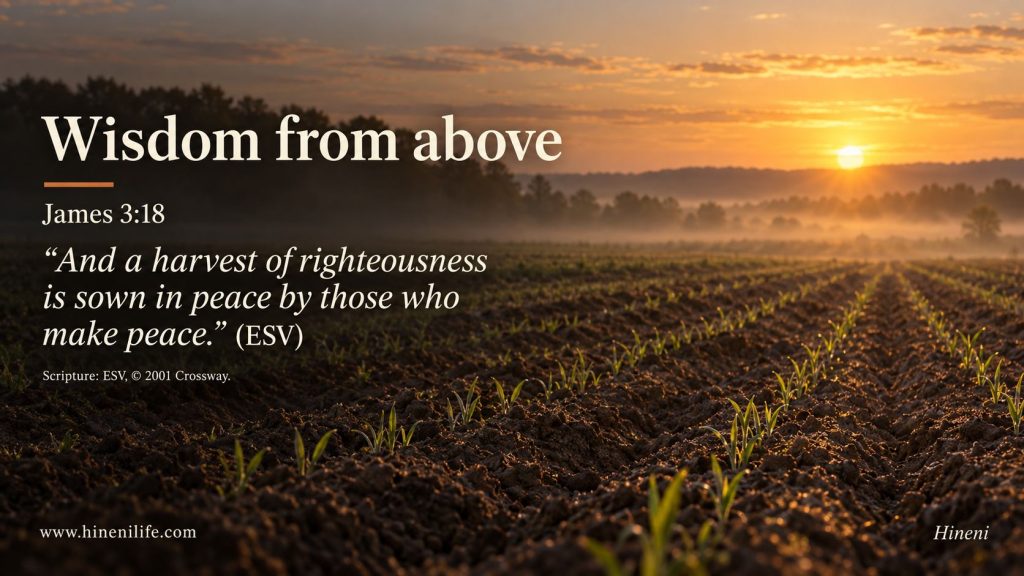
“And a harvest of righteousness is sown in peace by those who make peace.”
– James 3:18, ESV
A harvest does not appear overnight. It begins with seeds that are planted, often quietly and without immediate results.
In the same way, a life shaped by godly wisdom produces peace through everyday choices.
We can plant a seed of peace when we listen instead of reacting immediately, apologize instead of defending our pride, speak well of someone who is not present, refuse to spread a damaging story, or sincerely encourage someone whose success once made us uncomfortable.
Sometimes, making peace means taking the first step toward reconciliation. At other times, it means speaking the truth calmly, establishing a necessary boundary, or refusing to participate in gossip and division.
Biblical peace is not the same as pretending that nothing is wrong. It is the pursuit of what is right in a spirit shaped by God’s wisdom.
The harvest may take time. Others may not immediately respond to our efforts, and reconciliation may not always be possible. Yet we can remain faithful in the way we sow.
Imagine being the kind of person who leaves a conversation with greater understanding, enters a difficult situation without adding unnecessary hostility, and speaks about others in a way that protects their dignity.
That is a life in which wisdom from above is becoming visible.
The Word as a Mirror
James has already taught us that we must not merely hear the Word but also put it into practice (James 1:22-25). Now, James 3 invites us to examine the wisdom that shapes our lives.
As I reflect on this passage, I need to ask myself some uncomfortable questions.
- Do I serve because I love God, or because I want to be noticed?
- Whose success is difficult for me to celebrate?
- Have I ever used criticism to make another person appear smaller?
- Do I take secret satisfaction when someone who competes with me fails?
- Can I receive correction without immediately defending myself?
- Am I the same person in private as I am in public?
- Do I bring peace into the places I enter, or do my attitudes and words contribute to tension?
These questions are not meant to make us suspicious of every motive or condemn ourselves whenever we discover a weakness. They are invitations to honest examination.
Romans 8:1 reminds us that there is no condemnation for those who are in Christ Jesus. We do not have to hide from the truth about ourselves because our hope rests in Christ, not in our ability to appear faultless.
Grace does not encourage us to excuse our sin. It gives us the freedom to acknowledge it, repent, receive forgiveness, and pursue genuine change.
When God Reveals Something in Us
What should we do when this passage exposes jealousy, pride, selfish ambition, or insincerity in our hearts?
First, we must name it honestly before God. Instead of offering a vague prayer for forgiveness, we can confess the specific attitude or action He has brought to our attention.
Second, we should be willing to seek help from a trusted, mature believer when a struggle is persistent or difficult to overcome alone. James 5:16 encourages believers to confess their sins to one another and pray for one another.
Third, we must guard our words. When the urge arises to lower someone else, we can pause and ask whether what we are about to say is true, necessary, loving, and intended to help.
Fourth, we can deliberately practise the opposite of jealousy. Pray for the person we envy. Thank God for their gifts. Encourage them sincerely. Their growth does not have to diminish our own faithfulness.
Fifth, we can serve without seeking recognition, choosing opportunities to do good even when no one notices.
Finally, when our words or actions have harmed someone, we should be willing to apologize and make things right where possible.
These practices do not earn God’s favour, nor can we manufacture godly wisdom through willpower alone. They are responses of repentance and obedience as we depend on God’s grace and the transforming work of the Holy Spirit.
James reminds us in the following chapter that God gives grace to the humble (James 4:6). We can come before Him honestly, surrender our pride, and ask Him to shape our hearts according to His wisdom.
Becoming People of God’s Wisdom
The difference between earthly wisdom and wisdom from above is not simply the difference between bad behaviour and good behaviour. It is the difference between a life governed by selfish ambition and a life increasingly shaped by God’s character.
Earthly wisdom asks, “How can I rise above others?”
Godly wisdom asks, “How can I serve faithfully?”
Earthly wisdom feels threatened when someone else succeeds.
Godly wisdom can rejoice in the good God is doing through others.
Earthly wisdom uses words to defend pride or diminish people.
Godly wisdom speaks truth with gentleness and love.
Earthly wisdom creates rivalry and disorder.
Godly wisdom seeks what is pure, merciful, sincere, and peaceable.
As I meditate on James 3:13-18, I am reminded that I do not merely need to know what godly wisdom looks like. I need to allow God’s Word to examine the motives behind my actions and let His Spirit transform me.
The goal is not to develop a better spiritual image. It is to become more like Christ.
So today, I want to ask myself one final question:
Am I merely trying to appear wise before people, or am I allowing the wisdom that comes from above to shape who I am?
May the Lord help us to become people who do not compete for recognition, rejoice in another person’s downfall, or use our words to diminish others. May He make us sincere in our hearts, gentle in our responses, merciful in our judgments, and faithful in sowing peace.
Because the wisdom that comes from above is not merely something we speak about. It is something that should increasingly be seen in the way we live.
Father, thank You for Your Word, which reveals the condition of our hearts and leads us toward Your truth. Search me and show me where jealousy, selfish ambition, pride, or the desire for recognition has taken root. Forgive me for the times I have compared myself with others, struggled to rejoice in their success, or used my words in ways that diminished them. Deliver me from the desire to appear spiritual while neglecting the transformation You desire within me. Teach me to welcome correction, acknowledge my failures, and walk sincerely before You. Give me the wisdom that comes from above, wisdom that is pure, peaceable, gentle, open to reason, full of mercy and good fruits, impartial, and sincere. Help me to rejoice in what You are doing through others, serve faithfully without seeking applause, and use my words to build up rather than tear down. Make me a person who sows peace, not because I want to be admired, but because I want my life to reflect the character of Christ. May Your wisdom shape my thoughts, motives, words, and actions, so that I may grow in genuine humility and become more like Jesus. In Jesus’ name, Amen.
Hineni
Excellent article with a real message! That’s wisdom from above for sure 🙏
Thank you,and may God bless you. Glory to Lord Jesus Christ alone. Please keep reading.