
When What I Have Does Not Define Me
James 1:9-11
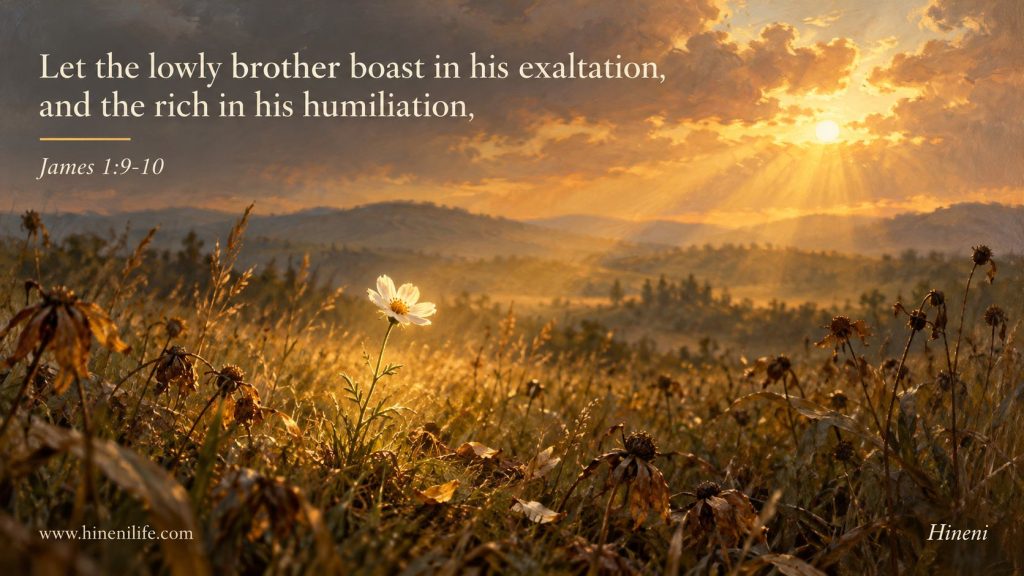
“Let the lowly brother boast in his exaltation, and the rich in his humiliation, because like a flower of the grass he will pass away.”
– James 1:9-10, ESV
James has been taking us through a meaningful progression.
He has spoken about trials, the need for wisdom, and the importance of trusting God without a divided heart. Now he brings that same heart examination into an area that can quietly influence us – our circumstances, possessions, and position.
The Lowly Brother
James says:
“Let the lowly brother boast in his exaltation…”
– James 1:9, ESV
The “lowly” brother is the believer who is socially or materially insignificant in the eyes of the world.
James does not tell him to become discouraged because he has little. Instead, he tells him to boast in his exaltation.
The world may measure a person’s importance by income, possessions, position, education, influence, or social standing.
But God does not measure us that way.
A believer who has very little materially may possess something infinitely greater – a new identity and standing in Christ.
His earthly circumstances do not determine his ultimate worth.
And Then James Speaks to the Rich
James then says:
“and the rich in his humiliation…”
– James 1:10, ESV
This is a surprising statement.
Why would a rich person boast in humiliation?
Because wealth can create a sense of permanence and security. But James reminds us that earthly wealth and status are temporary.
He gives us a picture from nature:
“For the sun rises with its scorching heat and withers the grass…”
– James 1:11, ESV
The grass may be green and beautiful. The flower may look attractive. Everything may appear healthy while conditions are favorable.
But the scorching heat comes, and the beauty fades.
James continues:
“so also will the rich person fade away in the midst of his pursuits.”
– James 1:11, ESV
That final phrase is striking: “In the midst of his pursuits.”
A person can spend his life pursuing wealth, possessions, success, recognition, and security, and yet all these things belong to a temporary world.
James is not saying that possessing wealth is automatically sinful. The deeper issue is whether temporary things have become the foundation of our identity and confidence.
What Defines Me?
This brings me back to what James said in verses 6-8 about being double-minded.
I can thank God for my abilities, money, opportunities, and position and use them responsibly. But I must not allow them to become the measure of who I am or the place where I ultimately put my trust.
If I have little, I can rejoice in what I have received in Christ.
If I have much, I can remember that what I possess is temporary.
This gives me a healthier way to look at both poverty and prosperity.
What I have can change. Who I am in Christ does not.
A Different Way to Live
If God has given me resources, I should steward them faithfully.
If He has given me abilities, I should use them for His glory.
If He has given me opportunities, I should use them wisely.
And whether I have much or little, I should not allow my circumstances to determine my worth.
James brings me to a simple question:
What defines me?
Is it what I have?
Is it what I can do?
Is it where I stand in society?
Or is my deepest identity found in Christ?
The flower fades.
The grass withers.
Wealth passes.
Positions change.
But Christ remains.
Lord, help me to see my circumstances and everything You have entrusted to me through Your eyes. Whether I have much or little, keep my heart centered on You. Teach me to steward what You have given me faithfully and to find my identity in Christ alone.
In Jesus’ name,
Amen.
Hineni
God bless you, brother