
13 August 2026
A Meditation on Exodus 27:9–19
A Boundary and a Way In
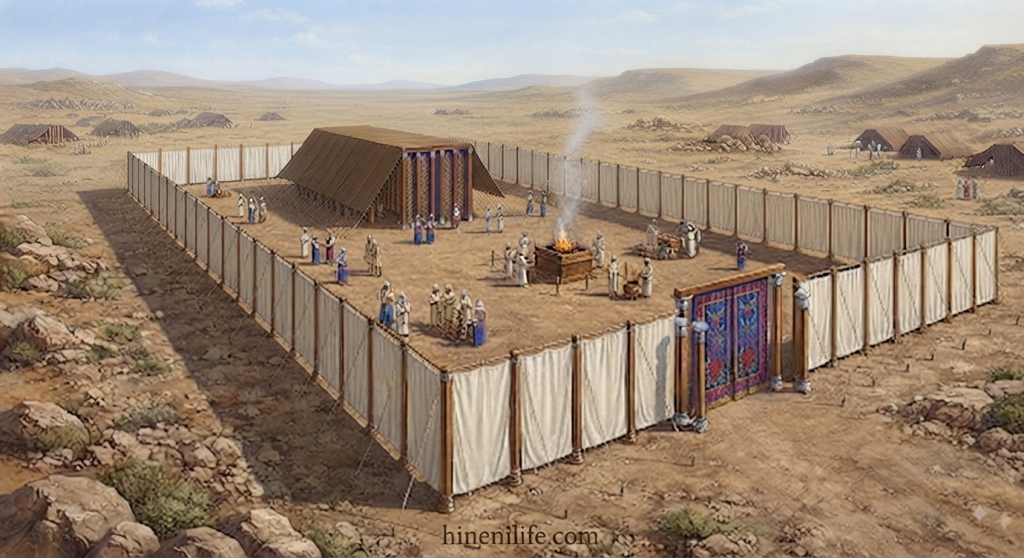
As I continued my meditation through Exodus 27, today’s passage brought my attention to the courtyard of the Tabernacle.
At first, these verses may appear to be simply another set of construction instructions. God gives Moses detailed instructions about its dimensions, curtains, pillars, bases and entrance. But as I meditated on the passage, two thoughts stood out to me:
There was a boundary. And there was an entrance.
These two truths have something important to teach us as New Testament believers.
The Courtyard Had a Boundary
God instructed Moses to construct the courtyard around the Tabernacle. The south side was to have curtains extending 100 cubits, supported by twenty pillars and twenty bases. The north side had the same arrangement. The west side was fifty cubits wide, while the eastern side also had a defined boundary, with an entrance in the middle.
The curtains were made of fine twined linen, and the entrance curtain was made with blue, purple and scarlet yarn and fine twined linen. God was creating a clear distinction between the surrounding camp and the place where He had established His dwelling.
This made me ask myself: “Do I have a boundary between my life and the influences of this world?”
We Are in the World, But Not of the World
We live in a world where information is constantly coming toward us. News. Social media. YouTube. Entertainment. Opinions. Advertisements. Conversations. Images. Messages.
We can receive an enormous amount of information every day without consciously deciding whether it should have a place in our minds. But as Christians, should everything available to us automatically be allowed to enter our hearts?
Paul gives us a clear principle:
“Do not be conformed to this world, but be transformed by the renewal of your mind…”
– Romans 12:2 (ESV)
Christian separation does not mean withdrawing from society. Jesus prayed for His disciples:
“I do not ask that you take them out of the world, but that you keep them from the evil one.”
– John 17:15 (ESV)
Jesus sent His followers into the world, but He did not want the world to control them. We are called to live in the world without allowing the world to shape our hearts.
What Am I Allowing Into My Heart?
This makes me examine the things that enter my life through my eyes and ears. What am I watching? What am I listening to? What conversations am I constantly absorbing? What opinions are shaping my thinking? What kind of entertainment is influencing me?
The psalmist says:
“I will not set before my eyes anything that is worthless.”
– Psalm 101:3 (ESV)
This does not mean that we must be unaware of what is happening around us. It means we need discernment. Not everything that attracts my attention deserves a place in my heart. Not everything I can watch is something I should watch.
A Christian needs the wisdom to say: “This may be acceptable to the world, but it is not helpful for my walk with Christ.”
What Comes Out of Me?
The courtyard also makes me think about what comes outwardly from our lives.
Jesus said:
“For out of the abundance of the heart the mouth speaks.”
– Matthew 12:34 (ESV)
This makes the matter deeper. It is possible to create an outward appearance of holiness while the heart remains unchanged.
What happens when someone insults me? What happens when someone disagrees with me? What happens when I don’t get what I want? What comes out of my mouth then? Anger? Pride? Harshness? Bitterness? Judgment? Or the character of Christ?
The boundary God desires is not merely an outward boundary. He wants holiness to begin in the heart and become visible in the way we live.
We Are the Temple of the Holy Spirit
For a New Testament believer, this becomes even more meaningful.
Paul writes:
“Your body is a temple of the Holy Spirit within you, whom you have from God.”
– 1 Corinthians 6:19 (ESV)
The Tabernacle was God’s dwelling place among Israel. Today, believers are described as the temple of the Holy Spirit.
Therefore, our Christian life cannot be separated from what we do with our bodies, minds, eyes, ears, words and relationships. A simple question can help us examine ourselves: “Would I willingly take the Holy Spirit with me into this?”
Would I watch this? Would I listen to this? Would I speak this? Would I participate in this? Would I allow this thought to remain in my mind?
Separation Does Not Mean Isolation
There is an important balance here. Jesus spent time with people who were far from God. He spoke with them, ate with them and entered their lives. But He was never controlled by their values.
That is the difference between separation and isolation. We are not called to disappear from society.
Jesus said:
“You are the light of the world.”
– Matthew 5:14 (ESV)
A light must shine where there is darkness. Our calling is to be present in the world while allowing Christ to remain Lord over our lives. We influence the world without allowing the world to define us.
The Boundary Had an Entrance
This is the part of today’s meditation that gives me the greatest joy. There was a boundary around the Tabernacle. But God did not simply say: “You cannot come in.”
There was an entrance. God Himself provided a way to approach His presence.
Jesus said:
“I am the door. If anyone enters by me, he will be saved…”
– John 10:9 (ESV)
And again:
“I am the way, and the truth, and the life. No one comes to the Father except through me.”
– John 14:6 (ESV)
We should be careful not to say that every measurement or architectural detail in the courtyard is a direct prophecy of Christ. Scripture does not give that interpretation for every detail. But the larger biblical picture is unmistakable: God is holy. Sin separates humanity from God. God provides the way for us to come near. And that way is ultimately revealed in Jesus Christ.
Holiness and Grace
The courtyard therefore reminds me of two truths that must remain together: God is holy. And: God invites us to come near.
We should never use God’s grace as an excuse for careless living. At the same time, we should never allow our failures to convince us that we cannot approach God.
Hebrews says:
“Therefore, brothers, since we have confidence to enter the holy places by the blood of Jesus…”
– Hebrews 10:19 (ESV)
And:
“Let us then with confidence draw near to the throne of grace, that we may receive mercy and find grace to help in time of need.”
– Hebrews 4:16 (ESV)
What an extraordinary privilege! The holy God has made a way for sinful people to come near. And that way is not our goodness or religious performance. It is Jesus Christ.
When We Fail, the Door Is Still Open
If I examine my life honestly, I will discover that I don’t always maintain the boundaries I should. Sometimes I allow things into my mind that I shouldn’t. Sometimes my words don’t reflect Christ. Sometimes I become anxious about things I cannot control. Sometimes I become angry or judgmental.
What should I do then? Should I hide from God? No. Because of Christ, I can come to Him. I can confess. I can repent. I can receive grace.
John writes:
“If we confess our sins, he is faithful and just to forgive us our sins and to cleanse us from all unrighteousness.”
– 1 John 1:9 (ESV)
The purpose of examining ourselves is not condemnation. It is repentance, restoration and transformation.
I Don’t Have to Carry Everything
Another thought came strongly to me during this meditation. There are so many things happening around us. Political events. Economic problems. Wars. Social conflicts. Other people’s opinions. Things happening far away. Things that are completely outside our control.
We don’t have to carry all of them in our hearts. This does not mean that Christians should become indifferent to suffering. When something genuinely concerns us, we can pray, help where possible, act responsibly and place the matter before God. But we don’t have to carry what belongs in God’s hands.
Peter tells us:
“Casting all your anxieties on him, because he cares for you.”
– 1 Peter 5:7 (ESV)
I can care without being consumed. I can be informed without becoming anxious. I can live in this world without allowing the world to control my heart.
A Personal Examination
As I stand before the mirror of God’s Word, I want to ask myself:
What am I allowing through my eyes? What am I allowing through my ears? What is filling my mind? What influences my decisions? What is coming out of my mouth? Do my reactions reveal Christ? Do my relationships reveal Christ? Is there something I need to remove from my life? Is there something I need to surrender to God?
These questions are not for judging somebody else. They are for examining my own life before God.
A Boundary and a Door
Perhaps this is the thought I want to carry from Exodus 27:9–19:
The courtyard had a boundary, but it also had a door.
The boundary reminds me: I belong to God. The entrance reminds me: God has made a way for me to come to Him.
The boundary reminds me of holiness. The entrance reminds me of grace.
The boundary reminds me not to allow the world to control my heart. The entrance reminds me that when I fail, I don’t have to run away from God.
I can come through Jesus Christ.
Lord, You have called me to live in this world, but not to be conformed to this world. Help me to build wise boundaries around my life. Guard my eyes. Guard my ears. Guard my thoughts. Guard my words. Guard my heart. Give me wisdom to recognize what is not good for my spiritual life and the courage to say no. When I am worried about things I cannot control, teach me to place them in Your hands. When I fail, help me not to hide from You. Help me to come boldly to Your throne of grace through Jesus Christ. Let the holiness of Your presence be reflected in my life. Let those around me see a life genuinely being transformed by Christ. Amen. There is a boundary. There is a door. And the door is open.
Hineni