
11 August 2026
📖 A Thought from My Personal Meditation
Exodus 26:31–37
As I continued my meditation through Exodus 26, I came to the final section of the chapter—verses 31 to 37.
At first glance, these verses may appear to be another set of detailed instructions about curtains, pillars, sockets, and their placement.
But when we look carefully, we discover that these instructions are revealing something much deeper.
God was teaching His people about His holiness, the separation caused by sin, the need for atonement, and ultimately the way by which humanity could approach Him.
And when we read these verses in the light of the New Testament, they point us beautifully to Jesus Christ.
The arrangement of the Tabernacle
Before looking at the individual verses, it is helpful to understand the arrangement.
The Tabernacle had two main sections:
The Holy Place
This was the first room.
Inside it were:
- the golden lampstand,
- the table of the bread of the Presence,
- and later, the altar of incense.
The Most Holy Place
This was the innermost room.
Inside it was:
- the Ark of the Covenant,
- with the mercy seat above it.
The Most Holy Place was associated with the special manifestation of God’s presence.
But there was a barrier between these two rooms.
That barrier was the veil.
And that veil becomes the central focus of Exodus 26:31–37.
Verse 31 — The veil
God commanded Moses:
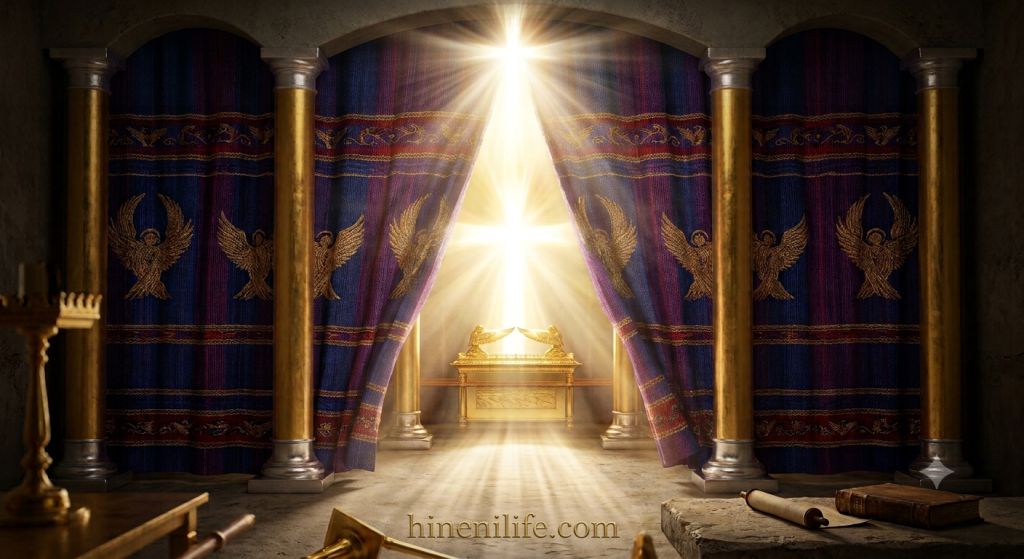
“And you shall make a veil of blue and purple and scarlet yarns and fine twined linen. It shall be made with cherubim skillfully worked into it.”
Notice the materials.
The same beautiful colours we saw earlier appear again:
blue, purple, scarlet, and fine linen.
And again, cherubim are included in the design.
This was not simply an ordinary curtain.
It had a very important purpose.
It would separate the Holy Place from the Most Holy Place.
Why were cherubim included?
This takes us back to the beginning of the Bible.
After Adam and Eve sinned, they were driven out of the Garden of Eden.
Genesis 3:24 says:
“He placed the cherubim and a flaming sword that turned every way to guard the way to the tree of life.”
That is an interesting connection.
In Eden, cherubim were associated with guarding the way to God’s presence.
In the Tabernacle, cherubim were woven into the veil that separated the Most Holy Place from the rest of the sanctuary.
We should not claim that the Bible explicitly says the cherubim on the veil were a direct representation of the cherubim in Eden.
But the biblical imagery is certainly striking.
Both passages remind us that God’s holiness is not something sinful humanity can approach casually.
Verse 32 — The veil was supported by pillars
God instructed Moses to hang the veil on four pillars of acacia wood overlaid with gold.
These pillars stood on four silver bases.
The veil therefore became a firm and visible separation.
It was not merely symbolic in the sense of being invisible.
There was an actual barrier.
The priests could minister in the Holy Place.
But the Most Holy Place was beyond the veil.
God was dwelling among His people, yet access was restricted.
This gives us an important truth:
God was near, but the way into His immediate presence was restricted.
Why?
Because humanity is sinful and God is holy.
Verse 33 — “The veil shall separate”
This is perhaps the most important verse in the passage.
God says:
“And the veil shall separate for you the Holy Place from the Most Holy.”
Notice the word:
Separate.
The veil was a boundary.
On one side was the Holy Place.
On the other side was the Most Holy Place.
And behind the veil was the Ark and mercy seat.
The message was unmistakable:
There is a separation between sinful humanity and the holy presence of God.
The Tabernacle was teaching Israel something about sin.
God desired to dwell among His people.
But sin prevented unrestricted access.
The veil and the holiness of God
We often speak about God’s love—and rightly so.
But the Tabernacle also reminds us that God is holy.
God’s holiness cannot simply be ignored.
The prophet Isaiah gives us a powerful picture of God’s holiness in Isaiah 6.
The seraphim cry:
“Holy, holy, holy is the LORD of hosts.”
Isaiah’s immediate response is:
“Woe is me! For I am lost.”
When a sinful human being encounters the holiness of God, he becomes aware of his own condition.
The Tabernacle was continually teaching Israel this truth.
God is holy.
Sin is serious.
Access requires God’s appointed way.
The Most Holy Place
The Most Holy Place contained the Ark of the Covenant.
Above the Ark was the mercy seat.
This was the place particularly associated with God’s presence.
But ordinary Israelites could not simply enter.
Even the high priest could enter only under the conditions God established, particularly on the Day of Atonement.
Hebrews 9:7 says:
“Into the second section only the high priest goes, and he but once a year, and not without taking blood…”
Blood was necessary.
Atonement was necessary.
The way was restricted.
But all of this was preparing God’s people for something greater.
Verse 34 — The Ark and the mercy seat
God says:
“You shall put the mercy seat on the ark of the testimony in the Most Holy Place.”
The mercy seat was the cover of the Ark.
It was associated with God’s presence and with the sacrificial system, particularly on the Day of Atonement.
Leviticus 16 describes how the high priest entered the Most Holy Place and dealt with the blood of the sacrifice in relation to the mercy seat.
Now we come to a remarkable New Testament connection.
Paul says concerning Christ:
“whom God put forward as a propitiation by his blood, to be received by faith.”
— Romans 3:25
The Greek word used here is closely related to the term for the mercy seat.
This gives us a beautiful picture.
The Old Testament system pointed toward atonement.
But Christ became the ultimate fulfillment.
Christ is the greater sacrifice
The sacrifices of the Old Testament had to be repeated.
Christ’s sacrifice did not.
Hebrews 9:12 says:
“He entered once for all into the holy places, not by means of the blood of goats and calves but by means of his own blood, thus securing an eternal redemption.”
Think about the contrast.
Old Covenant
Repeated sacrifices.
Christ
One perfect sacrifice.
Old Covenant
Earthly sanctuary.
Christ
Heavenly reality.
Old Covenant
Temporary priesthood.
Christ
An eternal High Priest.
The Tabernacle was pointing forward.
Verse 35 — The lampstand and the table
God then gives instructions concerning the furnishings in the Holy Place.
The table was placed outside the veil.
The lampstand was opposite it.
We have already studied the spiritual significance of these objects.
The lampstand reminds us of light.
Jesus said:
“I am the light of the world.”
— John 8:12
The lampstand provided light within the Holy Place.
But Jesus is the greater reality.
He doesn’t merely provide light.
He is the Light.
John 1:9 calls Him:
“The true light, which gives light to everyone.”
The table and the Bread of the Presence
The table held the Bread of the Presence.
This also points us toward Christ.
Jesus said:
“I am the bread of life; whoever comes to me shall not hunger.”
— John 6:35
Again, we need to be careful.
The Bible does not say that every detail of the table is a direct prophecy about Jesus.
But the larger pattern is clear.
The Tabernacle contains symbols and practices that find their greater fulfillment in Christ.
The lampstand reminds us of light.
The bread reminds us of life and provision.
And Christ declares:
“I am the light.”
“I am the bread of life.”
Verse 36 — The entrance curtain
God then gives instructions for another curtain:
“You shall make a screen for the entrance of the tent…”
This is important because we should distinguish between the two curtains.
The entrance curtain
This was the curtain through which the priests entered the Holy Place.
The inner veil
This separated the Holy Place from the Most Holy Place.
So there was an appointed entrance into the sanctuary and another barrier within the sanctuary.
Access to God was not something humanity could redesign according to its own preferences.
God determined the way.
And this prepares us beautifully for the words of Jesus.
“I am the way”
Jesus said:
“I am the way, and the truth, and the life. No one comes to the Father except through me.”
— John 14:6
The Tabernacle had an appointed way of entrance.
Jesus reveals the ultimate reality:
He Himself is the Way.
Christianity is not ultimately about discovering our own path to God.
It is about receiving the way God Himself has provided.
That way is Jesus Christ.
Verse 37 — The five pillars
The entrance curtain was hung on five pillars of acacia wood overlaid with gold, standing on bronze bases.
Again, we should resist the temptation to give a hidden symbolic meaning to every number.
The important point is that even the entrance was carefully designed according to God’s instructions.
God determined:
- where the entrance would be,
- how it would be constructed,
- what materials would be used,
- and how it would function.
The message is simple:
God determines the way we approach Him.
And in the New Testament, that way is revealed completely in Christ.
And then came the Cross
Now we reach the most powerful connection between this passage and the Gospel.
For centuries, the veil remained a visible reminder of separation.
But then Jesus came.
He lived a sinless life.
He became the perfect sacrifice.
He went to the cross.
And when He died, Matthew records:
“And behold, the curtain of the temple was torn in two, from top to bottom.”
— Matthew 27:51
Think about what had just happened.
The veil represented separation.
And at the death of Jesus:
The veil was torn.
The barrier was removed.
The way was opened.
And notice the direction:
from top to bottom.
This was God’s work.
Humanity did not force its way into God’s presence.
God Himself opened the way through the sacrifice of His Son.
Hebrews explains the meaning
The book of Hebrews makes this connection even more explicit.
Hebrews 10:19–20 says:
“Therefore, brothers, since we have confidence to enter the holy places by the blood of Jesus, by the new and living way that he opened for us through the curtain, that is, through his flesh…”
This is one of the clearest explanations we have.
The writer of Hebrews connects:
the holy place → access to God
the curtain → Christ’s flesh
the blood → Christ’s sacrifice
the opened way → access through Jesus
This is not merely an imaginative interpretation.
The New Testament itself tells us how the Tabernacle imagery finds its fulfillment in Christ.
The veil and the body of Christ
This phrase is particularly deep:
“through the curtain, that is, through his flesh.”
The veil represented restricted access.
Jesus gave His body in sacrifice.
Through His death, the barrier was removed.
So we can see the progression:
The veil → separation
Sin → the reason for separation
Sacrifice → the provision for atonement
Christ → the perfect sacrifice
The torn veil → access opened
Faith in Christ → reconciliation with God
This is the Gospel hidden within the structure of the Tabernacle.
From “Stay behind the veil” to “Draw near”
Perhaps one of the most beautiful changes in the New Testament is the change in invitation.
Under the old arrangement, access was restricted.
But after Christ’s sacrifice, Hebrews says:
“Let us then with confidence draw near to the throne of grace.”
— Hebrews 4:16
And again:
“Let us draw near with a true heart in full assurance of faith.”
— Hebrews 10:22
The message is no longer:
Stay far away.
The message is:
Draw near.
Why?
Because Christ has opened the way.
What an incredible privilege we have
Think about the privilege of a Christian today.
We can pray directly to God.
We can worship Him.
We can confess our sins.
We can read His Word.
We can seek His presence.
We can call Him Father.
We can draw near.
We don’t need another human being to stand between us and God as though Christ’s sacrifice were insufficient.
Christ is our mediator.
Paul says:
“For there is one God, and there is one mediator between God and men, the man Christ Jesus.”
— 1 Timothy 2:5
What the Tabernacle could only represent, Christ accomplished.
But access should never produce carelessness
There is another side to this truth.
Because we can come boldly to God, we should never assume that sin is insignificant.
The torn veil is not permission to live carelessly.
It is an invitation to live in relationship with God.
Grace does not make sin less serious.
Grace shows us how seriously God dealt with sin through the cross.
Paul asks:
“How can we who died to sin still live in it?”
— Romans 6:2
Therefore, the right response to grace is not:
“I can do whatever I want.”
It is:
“How can I live in a way that honours the One who gave Himself for me?”
Are we actually drawing near?
This became a very personal question for me while meditating on these verses.
Christ has opened the way.
But am I using that access?
Do I actually seek God?
Do I spend time with Him?
Do I pray?
Do I read His Word?
Do I confess my sins?
Do I listen to the Holy Spirit?
Do I desire His presence?
Or do I come to God only when I need something?
The veil has been torn.
The way is open.
But I still have to choose to walk that way.
The Tabernacle points us to Christ
When we look at Exodus 26:31–37 together with the New Testament, we can see a beautiful progression.
The veil
It separated the Holy Place from the Most Holy Place.
Christ opened the way to God.
The mercy seat
It was associated with atonement.
Christ became the perfect atoning sacrifice.
The High Priest
He entered the Most Holy Place according to God’s command.
Christ is our eternal High Priest.
The lampstand
It gave light in the Holy Place.
Jesus is the Light of the world.
The bread
It was placed before God on the table.
Jesus is the Bread of Life.
The entrance
There was a God-appointed way into the sanctuary.
Jesus is the Way.
The Tabernacle was never meant to be the final destination.
It was pointing forward.
And when we reach the New Testament, we find the fulfillment in Jesus Christ.
From the Tabernacle to the Church
There is another beautiful truth.
God once dwelt among His people in the Tabernacle.
Then Jesus came and dwelt among us.
John 1:14 says:
“And the Word became flesh and dwelt among us, and we have seen his glory.”
The word translated “dwelt” carries the idea of tabernacling.
The Tabernacle was God’s dwelling among Israel.
Jesus is God dwelling among humanity.
And after Christ’s ascension, the Holy Spirit came to dwell in God’s people.
Paul says:
“Do you not know that you are God’s temple and that God’s Spirit dwells in you?”
— 1 Corinthians 3:16
What a progression:
Tabernacle → Christ → Church
God among His people → God with us → God dwelling in His people
And one day this will reach its complete fulfillment.
Revelation 21:3 says:
“Behold, the dwelling place of God is with man. He will dwell with them, and they will be his people.”
The story comes full circle.
A Mirror for My Own Life
This is where I want to stop looking only at the Tabernacle and look at myself.
The Word of God is a mirror.
It shows us our condition.
The purpose is not merely to collect information.
The Holy Spirit brings conviction.
Our responsibility is to respond when God reveals something in our lives.
So I want to ask myself:
Have I truly come to Christ?
Am I drawing near to God?
Is there something in my life that I am deliberately keeping between God and me?
Have I confessed the sins that the Holy Spirit has revealed to me?
Am I taking God’s grace for granted?
Do I desire God’s presence, or only God’s blessings?
Am I maintaining a genuine personal relationship with Jesus Christ?
These are not questions for judging someone else.
They are questions I must first ask myself.
The greatest invitation
Exodus 26 teaches us about a veil.
The Gospel tells us that the veil was torn.
Hebrews tells us that the way has been opened.
And Jesus gives us the invitation:
“Come to me.”
— Matthew 11:28
The greatest privilege of Christianity is not merely receiving God’s blessings.
It is having access to God Himself.
The One who was separated from sinful humanity has made a way for us to come near.
Not because we deserve it.
Not because we are good enough.
But because Jesus Christ paid the price.
So today, I want to remember:
The veil was torn.
The way has been opened.
Christ has made access to God possible.
Therefore, let us not remain at a distance.
Let us draw near.
Let us confess.
Let us repent.
Let us believe.
Let us walk with Him.
Let us treasure His presence.
And let our lives reflect the grace of the One who opened the way.
“Let us draw near with a true heart in full assurance of faith.”
— Hebrews 10:22
The veil has been torn.
The way has been opened.
And the invitation remains:
Come near to God through Jesus Christ.
Hineni